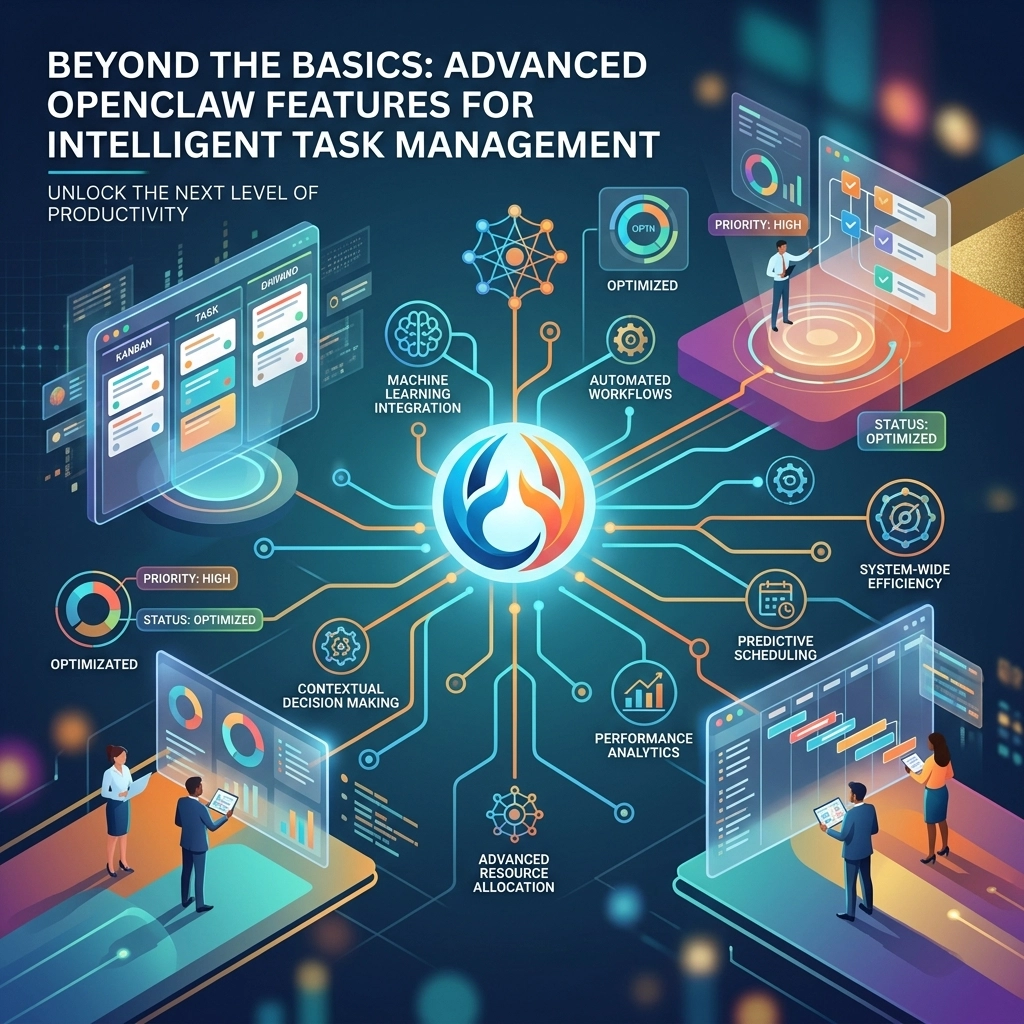
If you are still manually copy-pasting prompts into a chat interface to manage your daily operations in April 2026, you are essentially using a supercomputer as a paperweight. The era of "Simple Prompting" is dead. We have officially entered the age of Autonomous Task Orchestration, and at the center of this revolution sits OpenClaw.
At NV Seeds, we’ve seen the transition from basic automation to deep, multi-layered agentic workflows. While basic OpenClaw setups handle emails and calendar invites, the real ROI, the kind that cuts operational costs by 70%, lies in the advanced features. This post isn't for beginners. We are diving deep into openclaw features automation, subagent swarms, and the autonomous reasoning engines that are redefining how high-growth tech companies scale.
The Evolution of Automation: From Phase 1 to Phase 3
To understand where we are, we have to look at where we’ve been.
- Phase 1 (The Trigger Phase): Basic "If This, Then That" logic. If a form is filled, send an email. Useful, but rigid.
- Phase 2 (The LLM Phase): Using AI to summarize text or draft replies. This required constant human oversight and "babysitting."
- Phase 3 (The Agentic Phase): This is where we are now in 2026. Openclaw features automation allows for autonomous reasoning, where the system identifies the goal, breaks it into sub-tasks, and hires its own "subagents" to finish the job.

1. Autonomous Reasoning: The Brain Behind the Operation
The core of advanced OpenClaw implementation is its Autonomous Reasoning Engine. Unlike standard chatbots that provide a linear response, OpenClaw’s advanced reasoning allows it to pause, reflect, and iterate.
When you give OpenClaw a complex objective, for example, "Research our top five competitors' new pricing tiers and update our internal sales sheet", it doesn't just do a Google search. It utilizes a Chain-of-Thought (CoT) framework to:
- Verify the source credibility of the pricing data.
- Cross-reference the data with historical archives in your persistent SQLite vector database.
- Identify missing gaps (e.g., "Competitor X doesn't list their Enterprise price") and execute a specific browser automation to find LinkedIn posts or press releases that might hint at those numbers.
This level of openclaw features automation transforms the AI from a "writer" into a "research analyst."
2. Subagents and the "Swarm" Architecture
One of the most powerful (and underutilized) features is the ability to deploy subagents. Think of your primary OpenClaw instance as a Project Manager. In a complex workflow, this PM doesn't do all the work; it delegates.
How Subagent Swarms Work:
In a typical software development lifecycle at NV Seeds, we might use a swarm architecture for code reviews:
- The Lead Agent: Receives the GitHub pull request.
- The Security Subagent: Scans specifically for vulnerabilities.
- The Documentation Subagent: Ensures the README and inline comments are updated.
- The QA Subagent: Spins up a local container via shell commands to run unit tests.
By using openclaw features automation to manage these specialized subagents, you reduce "model hallucination" significantly. Because each subagent has a narrow, hyper-focused context, the accuracy of the output skyrockets.

3. Streaming Conversations and Real-Time Feedback Loops
In early 2025, we were used to the "waiting game", waiting for the little dots to bounce while the AI processed a massive task. In 2026, streaming conversations have changed the UX of task management.
OpenClaw now supports high-fidelity streaming that allows you to see the AI’s "internal monologue" in real-time. This isn't just for show. It serves a critical business function: Intervention.
If you see a subagent heading down a wrong logic path during a live stream, you can course-correct the execution without waiting for the entire process to finish. This saves tokens, time, and compute costs. For enterprises looking to optimize their cost of software development, this real-time oversight is a game-changer.
4. ClawRouter: The ROI Powerhouse
Let's talk about the bottom line. Running every single task through the most powerful, expensive LLM is a recipe for budget suicide. Advanced OpenClaw users leverage ClawRouter.
| Feature | Basic Usage | Advanced OpenClaw (ClawRouter) |
|---|---|---|
| Model Selection | Manual/Static | Dynamic based on task complexity |
| Cost Management | High (Flat rate) | Optimized (Up to 70% savings) |
| Latency | Variable | Low (Local models for simple tasks) |
| Efficiency | One size fits all | Precision routing |
By implementing openclaw features automation through ClawRouter, the system sends simple "Email Triage" tasks to a local Ollama instance (costing $0) while reserving the heavy-duty reasoning for GPT-5 or Claude 4 level models.
Case Study: Automating Logistics for "GlobalStream UK"
The Challenge: GlobalStream, a mid-sized UK logistics firm, was spending 40+ man-hours a week manually reconciling shipping manifests with customs declarations.
The Solution: NV Seeds implemented an OpenClaw swarm.
- Agent A (The Extractor): Used browser automation to pull manifests from three different carrier portals.
- Agent B (The Reconciler): Used semantic search via mem0 to compare manifest data against a decade of customs history to identify "High Risk" flags.
- Agent C (The Communicator): Automatically drafted and sent personalized emails to customs brokers for flagged items.
The Result:
- Manual labor reduced by 92%.
- Error rate dropped from 4% to 0.2%.
- ROI achieved in 4 months.
You can see more of our case studies here to see how we apply similar logic to different industries.
The Advanced OpenClaw Features Automation Playbook
If you’re ready to move beyond basic chat, follow this implementation roadmap:
- Audit Your Recurring Tasks: Identify any task that takes more than 15 minutes and happens daily.
- Map the Dependencies: Does the task require web access? Database access? Internal document reading?
- Deploy a Persistent Memory Layer: Use SQLite or a vector DB so your OpenClaw instance "remembers" your preferences across sessions.
- Set Up Cron-Based Automation: Don't wait for a human to start the task. Use OpenClaw’s scheduling features to run your daily briefings at 7:00 AM every morning.
- Monitor and Iterate: Use the streaming conversation feature to audit the "reasoning" of your agents once a week.
For companies that don't have the in-house expertise to build these complex swarms, our dedicated team at NV Seeds specializes in Gen AI agent development.
FAQ: Your Internal Monologue Answered
Q: Is OpenClaw secure for enterprise data?
A: Yes, provided you use local hosting options like Ollama or private VPC deployments. We always recommend keeping sensitive data within your firewall.
Q: How many subagents can I run at once?
A: Technically, as many as your compute allows. However, we find the "sweet spot" for most tech services is 3-5 specialized agents per workflow.
Q: Does this replace my project management software?
A: No, it supercharges it. OpenClaw can use APIs to update your Jira or Trello boards autonomously based on the work it completes.
Q: What is the biggest mistake companies make with OpenClaw?
A: "Prompt Bloat." Trying to put too many instructions into one single agent. The "Advanced" way is to break those instructions into five specialized subagents.
The Inflection Point
We are at a massive inflection point. The difference between companies that thrive and those that stagnate in 2026 comes down to how effectively they can orchestrate autonomous intelligence. Openclaw features automation is no longer a luxury; it’s the standard operating procedure for the modern enterprise.
If you are ready to stop "chatting" with AI and start "employing" it, let’s talk. NV Seeds is at the forefront of London's software development opportunities, and we’re ready to help you build your future.
Ready to scale your automation? Contact us today to schedule a consultation with our AI architects.
Leave a Reply