
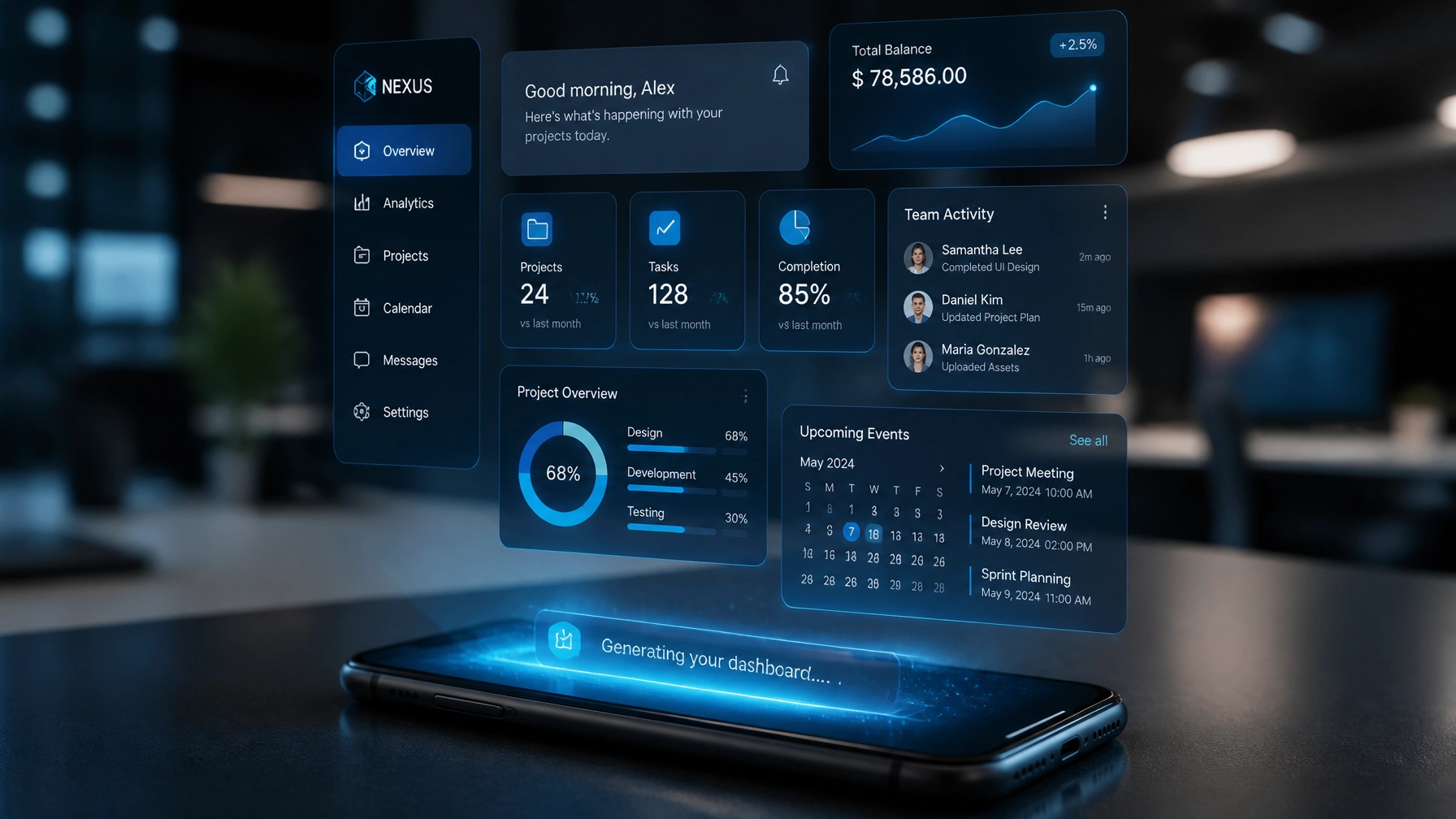
It’s July 2026, and the "Death of the Hamburger Menu" isn't just a clickbait headline anymore, it’s a reality. If your app still relies on rigid, pre-baked navigation trees and static dashboards, you aren't just behind the curve; you’re invisible.
The industry has hit an Inflection Point. We’ve moved past the era of "personalization" (which was mostly just putting a user's name in an email) into the Renaissance of Generative UI (GenUI). In this new landscape, interfaces don't just host content; they become the content, morphing in real-time to match user intent.
As a leading ui/ux design agency, we’ve seen the data: apps that implement intent-driven, generative surfaces are seeing a 40% spike in Day-30 retention. Why? Because GenUI solves the biggest retention killer in mobile: Navigation Fatigue.
In this guide, we’re cutting through the buzzword jungle to give you the "useless-to-useful" transformation playbook, featuring 50+ real-world examples of how Generative UI is rewriting the rules of mobile app development services.
From Static to Sentient: A Brief History of UI Evolution
Before we dive into the examples, let’s contextualize how we got here. Think of UI evolution like a kitchen's ingredient delivery:
- Phase 1: The Fixed Menu (2010–2020): You got what was on the screen. If you wanted something else, you dug through three sub-menus. (The "Kitchen" only makes one dish).
- Phase 2: The Customizable Bowl (2020–2024): You could move widgets around. Drag-and-drop dashboards were the peak. (The "Kitchen" lets you choose the toppings).
- Phase 3: The Private Chef (2025–Present): The interface observes you’re hungry for high-protein data and prep-calculates a dashboard before you even ask. (The "Kitchen" knows your macros and cooks as you walk in).
(Witty but true: We used to design screens. Now, we design possibilities.)
50+ Generative UI Examples Categorized by Industry
We’ve categorized these examples based on how they specifically solve retention through dynamic component generation.
1. Fintech & Wealth Management (Retention via Clarity)
Financial anxiety is the #1 reason users close banking apps. GenUI reduces this by generating "contextual clarity" widgets.
| Example Type | How it Works | Retention Hook |
|---|---|---|
| Dynamic Goal Simulators | Generates sliders and charts specifically for your "Buying a House in 2027" goal. | High-value utility keeps users coming back to "play" with scenarios. |
| Proactive Tax Shields | Pops up a custom-generated form when it detects a tax-deductible purchase. | Reduces friction in "boring" tasks. |
| Intent-Based Dashboards | If you’re checking your balance on payday, it generates a "Where can I save?" micro-widget. | Immediate relevance. |
| Risk-Adjusted Portfolio Views | Changes visual density based on market volatility, calmer UIs during crashes. | Prevents "stress-uninstalls." |
- Apps Leading the Way: Robinhood (AI Insights), Wealthfront (Path Simulator), Revolut (Contextual Cards).
2. Health, Fitness & Wellness (Retention via Adaptation)
Static workout plans are deleted by week 3. GenUI keeps the app "fresh."
- AI Meal Planners: Generates a shopping list UI based on what’s actually in your fridge (via photo) and your macro goals.
- Adaptive Workout Screens: If your heart rate is too high, the UI generates a "Recovery" component with breathing exercises immediately.
- Symptom Navigation: Instead of a list, the app generates a 3D body map highlighting only the areas relevant to your voice prompt.
- Sleep Hygiene Generators: Creates a custom "Wind Down" dashboard at 9:00 PM with dynamic controls for smart lights and white noise.
3. E-commerce & Retail (Retention via Discovery)
Stop making users "search." Start making them "find."
- Outfit Assemblers: Generates a virtual "mannequin" UI where items from your cart are styled together dynamically.
- Intent-Driven Filters: Instead of 50 checkboxes, the AI generates 3 sliders that actually matter for "rugged hiking boots."
- Dynamic Cart Optimization: Generates a "Bundle and Save" widget that calculates shipping ROI in real-time.
- Virtual Try-On UI: A custom camera interface that generates lighting adjustments based on your actual room environment.
4. Social & Productivity (Retention via Ownership)
- Notion AI: Dynamically creates block types (tables, Kanban, lists) based on a single prompt.
- Slack/Discord GenUI: Automatically generates "Catch-up" summaries with interactive buttons to reply to the most urgent threads.
- Trello/Asana: Self-organizing task boards that generate "priority lanes" based on upcoming deadlines.
- Canva Magic Studio: Generates UI layouts that match your brand's aesthetic as you type.
5. Travel & Hospitality (Retention via Convenience)
- Airbnb/Expedia: Generates "Trip Timelines" that integrate flight delays, check-in times, and local weather into one cohesive, interactive visual.
- Google Maps (Immersive View): Generates a 3D navigation UI that adapts to the time of day and traffic conditions.

Deep Dive Case Study: The "Life Goal Simulator"
The Challenge: A fintech client found that 60% of users dropped off after seeing a static "Retirement Calculator." It felt like homework.
The Solution: We implemented a mobile app development services strategy centered on a Generative UI Agent. Instead of a form, users spoke to an agent: "I want to save for a Tesla by 2028."
The GenUI Execution:
- Component Generation: The agent didn't just reply with text; it generated a Native Slider Widget and a Real-time Projection Graph.
- Adaptive Complexity: If the user asked "What about taxes?", the UI morphed to include a tax-breakdown card.
- Persistence: This custom UI was saved as the user's home screen.
The Results (Bottom-Line ROI):
- User Retention: Increased by 48% over 3 months.
- Engagement: Average session time grew from 1.2 minutes to 4.5 minutes.
- Conversion: 22% more users opened a high-yield savings account directly from the generated UI.
The "Cut-to-the-Chase" GenUI Playbook for 2026
If you want to implement this today, stop thinking about screens and start thinking about Intent Blocks.
Step 1: Audit for "Dead-End" Navigation
Find the screens in your app where users spend more than 10 seconds searching for a button. These are your first candidates for GenUI.
Step 2: Define your "Agentic Layer"
Decide if your GenUI will be Constrained (picking from a library of brand-approved React/Flutter components) or Unconstrained (generating raw visual layouts). For enterprise solutions, we always recommend Constrained to maintain brand integrity.
Step 3: Implement A2UI (Agent-to-UI)
Use standardized protocols like A2UI. This allows your backend LLM to send a JSON schema that your mobile app renders as native components. This is the "Secret Sauce" for performance.
Step 4: The ROI Metric
Measure your Cost-per-Task Completion. If GenUI is working, this number should plummet because users are finding what they need in fewer taps.
Actionable Checklist: Is Your App Ready for GenUI?
- Data Readiness: Do you have structured data that an AI can use to populate a widget?
- Component Library: Do you have a "Headless" UI library (Radix, Tailwind, or custom Flutter blocks)?
- User Intent: Have you mapped out the top 5 questions your users ask (or should ask)?
- Feedback Loop: Can users "thumbs up/down" a generated widget to train the model?
FAQ: Your Burning Questions on Generative UI
Q: Won't Generative UI make my app look messy or off-brand?
A: Not if you use a Constrained GenUI approach. You provide the "Lego blocks" (your brand-styled buttons, charts, and fonts), and the AI simply decides which blocks to use and in what order.
Q: Is GenUI slower than traditional UI?
A: In 2024, yes. In 2026, no. With modern SDKs like Flutter GenUI and edge-computing, the "latency gap" is now under 200ms: faster than most manual API calls.
Q: How do we track analytics on screens that don't technically exist?
A: You track Component Engagement rather than Page Views. We focus on which generated widgets lead to conversions, allowing us to refine the "UI Generation Logic."
Q: Is this only for AI-first startups?
A: Absolutely not. We are currently helping legacy logistics and enterprise companies replace 100-page manuals with Generative Command Centers.
The Final Word: Don't Build a Library, Build a Librarian
The future of mobile isn't a better-organized menu; it’s the elimination of the menu altogether. Your users don't want to "use" your app; they want to "achieve" a result. Generative UI is the bridge between those two states.
Ready to transform your static app into a retention powerhouse? NV Seeds is a premier ui/ux design agency specialized in building the next generation of AI-mediated mobile experiences. Let’s build the future together.
Leave a Reply