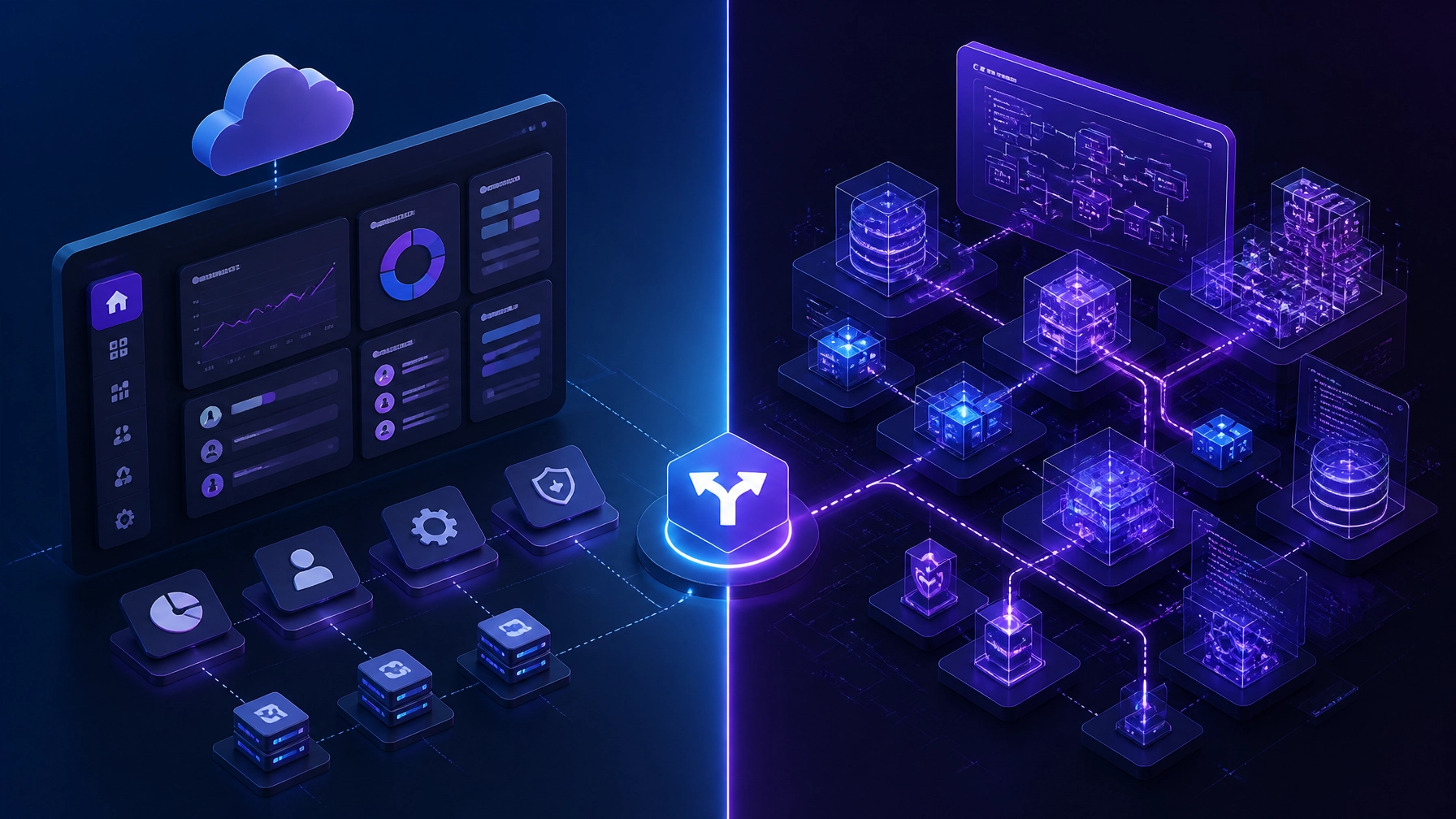
If you’re sitting in a boardroom in July 2026, still asking "Should we just buy a subscription or build it ourselves?", you’re already behind the curve.
For years, the industry standard was a "SaaS-first" mandate. It was the safe bet, low upfront costs, quick setup, and someone else's problem to maintain. But we’ve hit an Inflection Point. As of mid-2026, the global custom software development market has exploded to $65 billion, growing at a staggering 22.1% annually. Why? Because businesses have realized that "standard" software produces "standard" results.
In a world where 72% of companies now outsource their tech needs to gain a competitive edge, the "useless-to-useful" transformation isn't about having a tool; it's about owning the logic that drives your revenue.
The Evolution: From "Off-the-Shelf" to "Built-to-Win"
To understand where we are, we have to look at how we got here. Let’s take a quick lap through the phases of software adoption:
- Phase 1 (The Legacy Era): Buying physical discs and installing them on local servers. If it broke, you called a guy.
- Phase 2 (The SaaS Renaissance): Everything moved to the cloud. You traded ownership for a monthly bill. It was the era of "good enough."
- Phase 3 (The Custom Powerhouse – 2026): SaaS platforms have become bloated and expensive. Companies are reclaiming their workflows by building specialized, high-ROI platforms that do exactly what they need, and nothing they don't.
SaaS Platform Development: The Speed Trap?
Don't get it twisted: SaaS platform development is still a powerhouse for validation. If you need to test a concept in two weeks, SaaS is your best friend. It’s like renting a pre-furnished apartment; you can move in tonight, but you can’t knock down the walls to make the kitchen bigger.
The True Cost of "Cheap" SaaS
Initially, SaaS looks like a bargain. But look at your projections for 2027 and 2028.
- Subscription Creep: That $50/user/month seat adds up when you hit 500 employees.
- Integration Friction: You spend more time (and money) trying to get five different SaaS tools to talk to each other than you would have spent building one unified system.
- The "Average" Penalty: SaaS is built for the average user. If your business has a unique 1% workflow that gives you a market advantage, a SaaS tool will likely force you to break that workflow to fit their template.

Custom Software: The Strategic Strategic Lever
When we talk about custom software development, we aren't talking about "reinventing the wheel." We're talking about building a custom engine for a very specific race.
In 2026, the ROI of custom software isn't just about avoiding monthly fees. It's about operational efficiency. Recent data shows that moving from generic SaaS stacks to custom-tailored workflows can increase team efficiency by up to 30%.
Why Custom is Winning in 2026:
- Full IP Ownership: You aren't just a customer; you're an owner. This is a massive valuation booster for startups and enterprises alike.
- Scalability Without Permission: In the SaaS world, scaling often means moving to a "Pro" or "Enterprise" tier that doubles your cost overnight. With custom builds, you scale your infrastructure on your terms.
- Fortress Security: Multi-tenant SaaS means if the provider gets hit, you get hit. With a custom stack, you control the perimeter. (Note: 48% of tech leaders in 2026 cite data residency and security as their primary reason for going custom).
Case Study: NV Seeds’ 500th Milestone , The Fintech Transformation
At NV Seeds, we recently hit our 500th successful project delivery, a massive enterprise platform for a global fintech giant.
The Anxiety: The client was losing millions in "bridge costs", manual work required because their three main SaaS tools didn't handle their proprietary risk-assessment logic. They were stuck in a Phase 2 loop.
The Solution: We replaced their fragmented SaaS stack with a single, custom-built enterprise application.
The Result (ROI Metrics):
- Time-to-Market: 10 weeks from concept to V1.
- Cost Savings: $1.2M saved in annual licensing fees alone.
- Performance: 45% faster transaction processing thanks to a tailored cloud infrastructure.
- Outcome: They didn't just save money; they owned a proprietary tool that their competitors couldn't buy off the shelf.

The Decision Matrix: SaaS vs. Custom
Think of your software like a kitchen. SaaS is a meal kit, convenient, but you can't change the ingredients. Custom software is a professional kitchen designed around your specific menu.
| Feature | SaaS (Standard) | Custom Software (Premium) |
|---|---|---|
| Upfront Cost | Low (OpEx) | Higher (CapEx) |
| Launch Speed | Days/Weeks | 6–12 Weeks |
| Long-term ROI | Decreases as you scale | Increases as efficiency grows |
| Security | Shared / Vendor-dependent | Private / You own the keys |
| Competitive Edge | Zero (Everyone has it) | High (It's your secret sauce) |
Your 2026 Playbook: Which Way to Turn?
If you’re feeling the "technical talent shortage" or budget anxiety, follow this actionable checklist to decide:
- Is this a core revenue driver? If the software is the business or powers your unique value prop, build custom.
- Is this a commodity task? (e.g., Email, basic HR, internal chat). Use SaaS.
- Do you have a 3-year horizon? If yes, the TCO of custom software almost always beats SaaS subscription fees.
- Is your data highly sensitive? If you're in Fintech, Healthcare, or Legal, custom gives you the compliance control you need.
Bottom Line: The Powerhouse Approach
In 2026, the most successful companies are using a Hybrid Strategy. They use SaaS for the "boring" stuff and invest their capital into custom web and mobile applications that differentiate them in the market.
At NV Seeds, we don’t just write code; we transform ideas into powerful digital solutions. With a 98% client satisfaction rate and a global team across 20+ countries, we’ve seen every mistake in the book: and we know how to help you avoid them.
FAQ: Your Internal Monologue, Answered
"Isn't custom software going to take a year to build?"
Not anymore. With agile methodology and the modern frameworks we use at NV Seeds, we’re shipping production-ready custom apps in 6 to 12 weeks.
"What if my requirements change halfway through?"
That’s exactly why we use agile. We build in sprints, meaning you see progress every two weeks and we pivot as the market (or your boss) demands.
"Can we integrate our existing tools into a custom platform?"
Absolutely. We specialize in API development and integration, ensuring your new custom powerhouse talks perfectly to your legacy systems.
"What's the typical cost?"
For most mid-to-enterprise level apps in 2026, you're looking at a range of $50,000 to $250,000. Compare that to $10,000/month in SaaS fees over three years, and the math does itself.
Ready to stop renting your success and start owning it?
Contact NV Seeds today and let’s talk about building your 2026 growth engine.
Leave a Reply