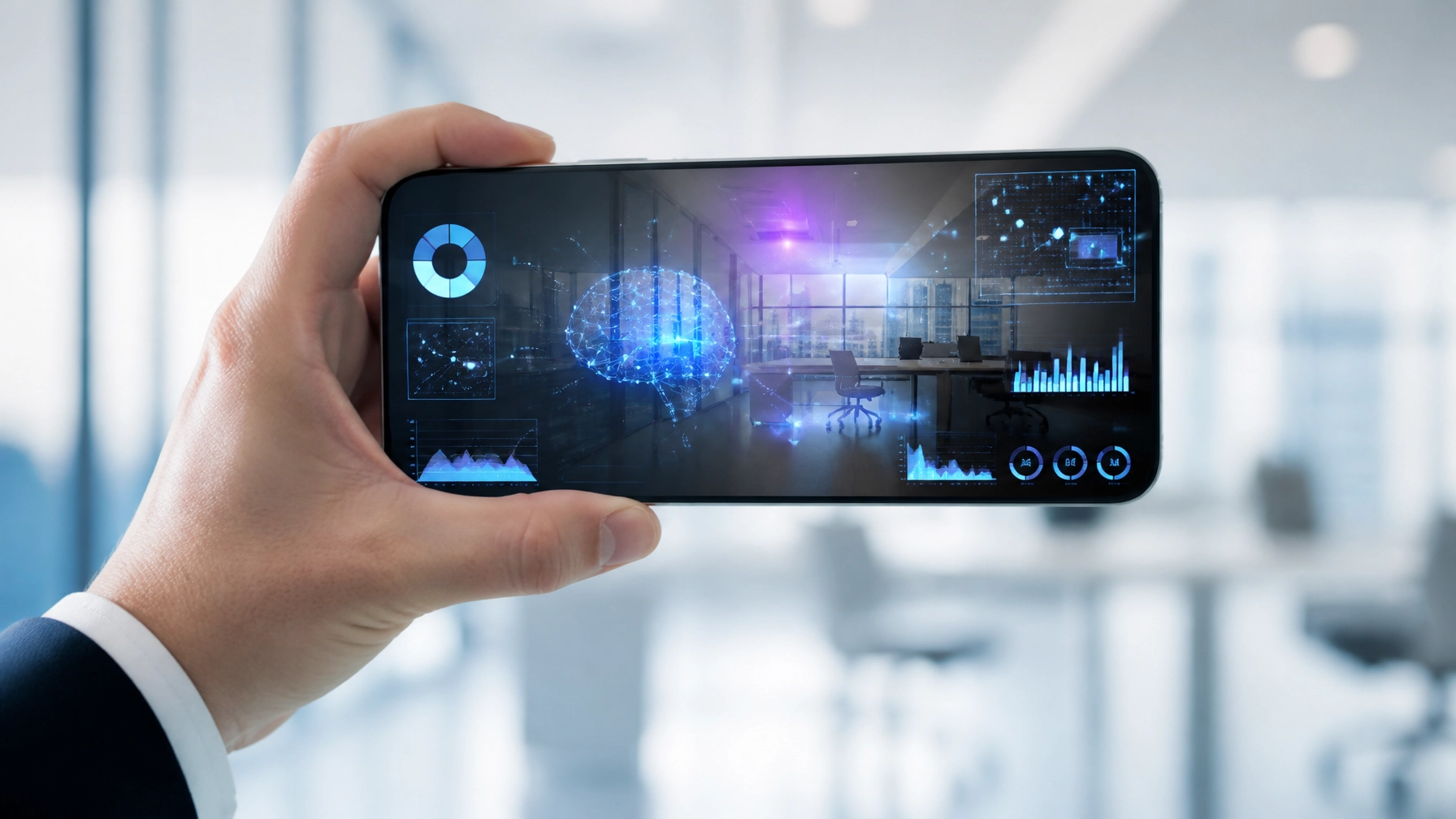
It’s June 2026, and the digital landscape has shifted. If your mobile app still treats AI like a fancy remote-controlled toy, sending every single user interaction to a cloud server and waiting for a response, you’re not just behind the curve; you’re a liability.
Remember the days when we were okay with a "loading…" spinner every time we asked an app to translate a sentence or identify a product in a photo? Those days are as dead as the headphone jack. Today, the most successful custom software development isn't about how much data you can pump into the cloud; it’s about how much intelligence you can pack into the user's pocket.
At NV Seeds, we’ve seen this transition first-hand. We’ve moved from "Cloud-First" to "On-Device-First," and the results for our clients have been nothing short of a Renaissance in User Experience.
The Evolution of Mobile Intelligence: A Quick Lap
To understand where we are, we have to look at how we got here. The evolution of mobile AI has moved through three distinct phases:
- Phase 1: The Novelty Era (2018-2022): AI was a gimmick. Apps used basic ML for things like "Portrait Mode" or simple predictive text. Most of the heavy lifting happened in massive data centers.
- Phase 2: The API Boom (2023-2025): Every app integrated LLMs via APIs. It was smart, but it was slow, expensive, and a privacy nightmare. You were essentially "renting" intelligence.
- Phase 3: The Powerhouse Era (Current – 2026): This is where we are now. With the latest Neural Processing Units (NPUs) inside every flagship phone, we’re running complex vision, voice, and reasoning models locally. Intelligence is now "owned," not rented.
Why Cloud-Only AI is Your "Useless-to-Useful" Bottleneck
Think of cloud-based AI like a high-end restaurant that only does delivery. No matter how good the chef is, you’re still waiting for a driver to navigate traffic, find your house, and hand you the food. By the time it arrives, it’s lukewarm.
On-device AI is your fridge. You open the door, and the ingredients are right there. Instant. Fresh. Reliable.
If you are undergoing digital transformation consulting, your priority shouldn't be "how do we add more AI?" It should be "how do we make our AI instant?"
The Big Three: Privacy, Latency, and Reliability
1. Privacy: The Digital Vault
In 2026, user trust is the most valuable currency. With global privacy regulations tightening, sending sensitive biometrics or financial data to a server is a massive risk.

When we build apps at NV Seeds, we utilize On-Device ML to ensure that raw user data never leaves the device. Whether it’s a healthcare app analyzing vitals or a fintech tool detecting fraud patterns, the "thinking" happens locally.
- The Bottom Line: You reduce your compliance headache (GDPR, HIPAA) and give your users the ultimate "Privacy-First" promise.
2. Latency: The 22ms Revolution
Latency is the silent killer of conversion. Research shows that moving AI tasks from the cloud to the device reduces processing time from 150ms+ to under 22ms.

When your app responds instantly to a gesture or a voice command, it feels like magic. When it waits for a round-trip to a server, it feels like a tool. In a world where 65% of new enterprise apps embed AI, "fast enough" is no longer an option.
3. Reliability: The Offline Edge
We’ve all been there, in a basement, on a plane, or in a "dead zone", trying to use an app that won't load because it can't "phone home" to its AI brain. On-device AI makes your app bulletproof. It works in the subway, it works in the air, and it works when your servers are under heavy load.
The Business Case: ROI and Measurable Outcomes
Let’s cut to the chase. Why should your C-suite care about on-device AI? Because it directly impacts the P&L.
| Metric | Cloud-Based AI | On-Device AI (2026 Standard) | Business Impact |
|---|---|---|---|
| Operational Cost | High (Per-API call fees) | Zero (Local compute) | 40-60% reduction in infrastructure spend |
| Response Time | 200ms – 2s | 10ms – 50ms | 15% lift in user retention rates |
| Data Security | High Risk (Data in transit) | Low Risk (Data at rest) | Massive reduction in cyber-insurance premiums |
| Offline Capability | Non-existent | Full functionality | Expansion into low-connectivity markets |
Case Study: Retail Vision with NV Seeds
The Challenge: A global retail client wanted to integrate an "Instant Search" feature where users could point their camera at any item in a store and see reviews, stock levels, and styling tips.
The Old Way: Sending 4K video frames to a cloud server for object detection. Result? A 3-second lag and $15,000/month in server costs.
The NV Seeds Solution: We built a custom mobile app using modern mobile app development services, implementing a quantized vision model that runs entirely on the phone’s NPU.
The Results:
- Latency: Reduced from 3,000ms to 45ms.
- Cost: Eliminated monthly AI API fees entirely.
- Conversion: A 42% increase in "Add-to-Cart" actions because the experience felt seamless.
(Witty but true note: Our developers spent more time choosing the right snack for the launch party than they did worrying about server scaling issues, because, well, there were none.)
How to Get Started: The On-Device AI Playbook
If you're ready to stop renting intelligence and start owning it, follow this checklist:
- Audit Your AI Workflows: Identify which features (vision, text generation, audio) are currently cloud-dependent.
- Quantize Your Models: Work with a team that knows how to shrink massive models down to run on mobile hardware without losing accuracy.
- Prioritize Privacy-Sensitive Data: Start by moving any feature that handles PII (Personally Identifiable Information) to the device.
- Leverage Native Frameworks: Use Core ML (iOS) and ML Kit (Android) to squeeze every bit of performance out of the hardware.
- Choose the Right Partner: Don't hire a "generalist" agency. You need engineers who understand NPU architecture and edge computing.
At NV Seeds, we don't just build apps; we transform ideas into powerful digital solutions that drive real business growth. Our global team of expert developers has delivered 500+ successful projects, and we’re ready to help you navigate the Inflection Point of 2026.
FAQ: Your Internal Monologue Answered
"Is on-device AI only for high-end phones?"
Nope! While the latest flagships are powerhouses, even mid-range devices in 2026 have dedicated AI silicon. We optimize models to "gracefully degrade": running full speed on NPUs or efficiently on GPUs for older hardware.
"Doesn't running AI on the phone drain the battery?"
Actually, the opposite is often true. Sending data over 5G/6G radios is incredibly power-hungry. Local NPU processing is designed specifically for efficiency, often using less power than a steady data stream.
"What if I need a massive model like GPT-5?"
We use a Hybrid Architecture. The "small, fast stuff" (UI interaction, data filtering, local search) happens on-device. The "massive, deep reasoning" happens in the cloud. It’s the best of both worlds.
"How do I know if my business is ready?"
If you have a mobile app and you aren't satisfied with your cloud costs or user engagement speeds, you were ready yesterday. Let's get in touch and build something faster.
Leave a Reply