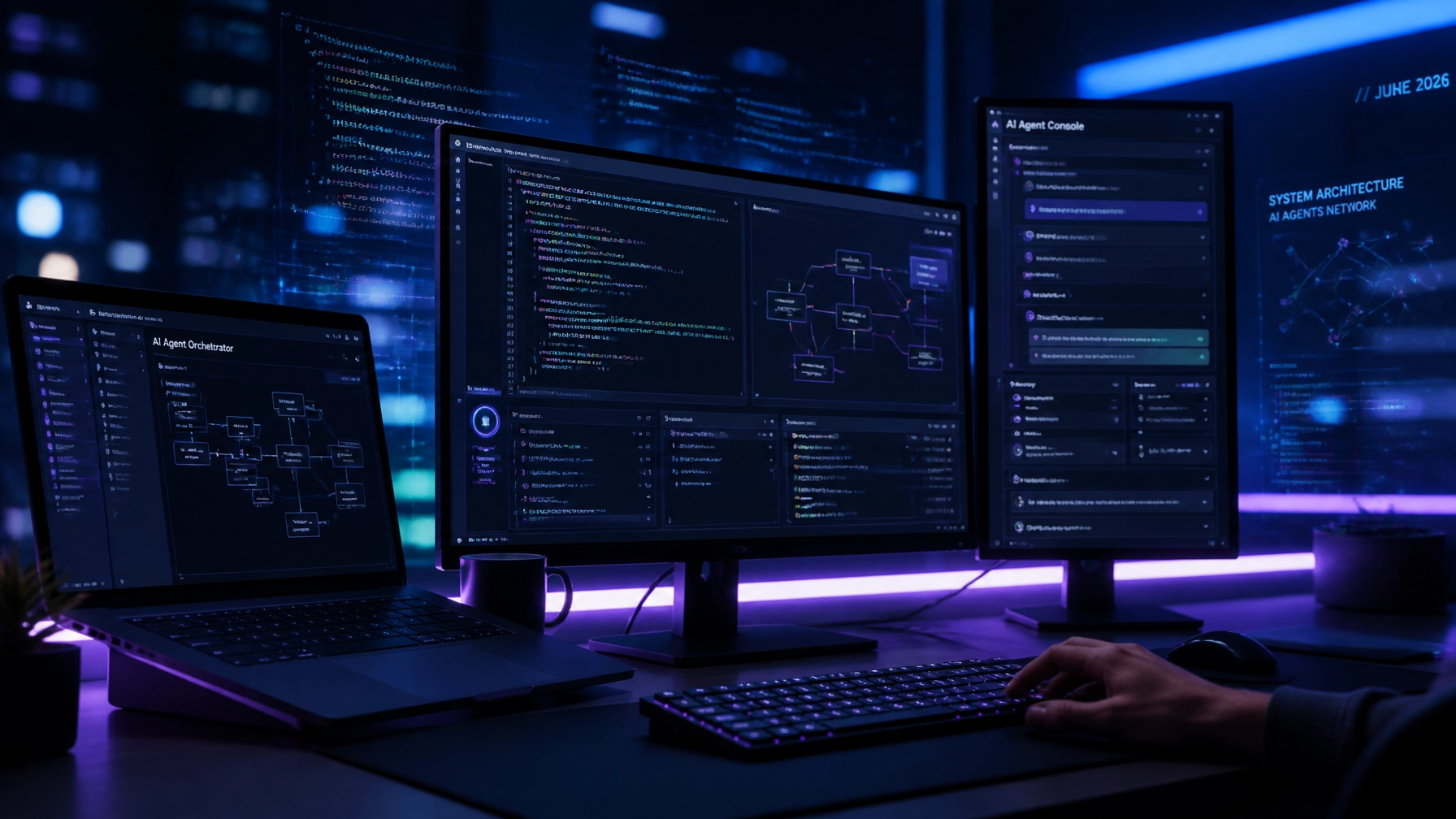
It is June 2026, and if your engineering team isn't using AI agents like Cursor, Windsurf, or custom-tuned LLMs, you’re essentially trying to win a Formula 1 race with a horse and buggy. But here is the cold, hard truth of the "Renaissance of Vibe Coding": Most companies are currently drowning in a sea of high-velocity garbage.
We’ve officially moved past the "Will it work?" phase and entered the "Why did it break at 3 AM?" phase. At NV Seeds, we’ve seen a 400% increase in digital transformation consulting requests from enterprises that rushed into AI-assisted coding in 2024 and are now hitting a brick wall of technical debt.
The promise was simple: 10x productivity. The reality? 10x the complexity, silent security leaks, and a crumbling architectural foundation.
If you want to save your custom software development projects from becoming an unmaintainable "Prompt-enstein’s Monster," you need to stop making these seven critical mistakes.
1. The "80% Trap": Shipping Proof-of-Concepts as Production Code
The most dangerous thing an AI coding tool can do is give you a solution that looks like it works. In 2026, LLMs are incredible at the "happy path", the logical flow where everything goes right.
The Mistake: Developers accept the AI’s output as "done" because the UI looks great and the primary function works. They ignore the missing 20%: edge cases, error handling, logging, and performance at scale.
The Fix: Treat AI-generated code like a smart but inexperienced intern. It needs a senior’s eye for the "boring" stuff. At NV Seeds, our custom software development services mandate that every AI-assisted module passes a "Resilience Audit" that specifically hunts for the missing 20%.
2. "Prompt Sprawl" and the Lack of Versioned Intent
Think of your prompts as the new source code. Most teams treat prompts like throwaway Slack messages. They copy-paste a 2,000-word instruction into a chat window, get a result, and move on.
The Mistake: This "Prompt Sprawl" means the logic behind your software is scattered across a dozen different developer's chat histories. When the model updates (as GPT-5 or Claude 4.5 did recently), your "magic" instructions no longer work, and no one knows why.
The Fix: Move your "Golden Prompts" into your repository. Use .prompt files. Version control them. Treat the intent behind the code with the same reverence as the code itself.
3. Blind Trust in Pattern Duplication
AI is a pattern-matching machine. If your codebase already has a slightly inefficient way of handling database queries, the AI will faithfully replicate that inefficiency across 50 new files in seconds.
The Mistake: Scaling bad architecture at light speed. We call this "Automated Rot." By the time you realize the pattern is flawed, the AI has already woven it into the fabric of your entire SaaS platform.
The Fix: Before unleashing AI agents on a large-scale refactor, manually define a "North Star" pattern. Use tools to bake your architectural constraints into the AI’s context window so it can only replicate the best version of your code.

4. Ignoring the "Ghost" Security Vulnerabilities
AI doesn't understand your security posture; it understands what code usually looks like on the internet. In 2026, we are seeing a surge in "Prompt Injection" vulnerabilities where AI-generated code inadvertently trusts user input in ways a human wouldn't.
The Mistake: Failing to run specialized security scanners on AI-generated segments. Traditional linters often miss the subtle logic flaws, like a leaked API key in a commented-out section or an overly permissive CORS policy, that AI tools love to hallucinate.
The Fix: Implement an "AI-First" CI/CD pipeline. Every PR containing AI-authored code should trigger an automated security audit. If you’re unsure how to set this up, our digital transformation consulting team specializes in building these guardrails.
5. Measuring Throughput, Not Quality (The "PR Factory")
Your CTO is happy because Pull Request (PR) volume is up 60%. But your "Cost-per-Task" is actually rising because your senior devs are spending 4 hours reviewing a 10-minute AI generated PR.
The Mistake: Using 2022 metrics for 2026 workflows. Lines of code (LOC) and PR counts are useless when a machine is writing the lines.
The Bottom Line: If your seniors are turning into "Code Janitors", cleaning up after messy AI agents, your ROI is negative. You aren't faster; you're just deferring the cost to the future.
6. The Erosion of "Senior-Level" Architectural Thinking
This is the most subtle danger. When you outsource the implementation to AI, you risk losing the mental model of the system.
The Mistake: Using AI as a crutch instead of a telescope. If your developers don't understand the "Why" because the AI handled the "How," they won't be able to fix the system when it inevitably hits a 2026-scale traffic spike.
The Fix: Use a "Whiteboard First" approach. Use AI to challenge your architecture, not just write it. Ask the AI: "Find 5 ways this design will fail under 10x load." This keeps your human talent in the driver's seat.
7. Lacking a Governance Framework for LLM Usage
Who owns the IP of a code block written by 4 different models? What happens if a developer pastes your proprietary fintech algorithm into a public-facing LLM?
The Mistake: Having "Shadow AI" usage where every dev uses their own personal, unvetted tool. This is a compliance nightmare waiting to happen.
The Fix: Create an internal "AI Constitution." Define which models are allowed, what data can be shared, and how AI-authored code must be tagged. Transparency is the only way to maintain a high-performance dedicated team.
Case Study: Rescuing a Legacy SaaS from "Vibe Coding" Debt

The Client: A mid-sized healthcare logistics provider in the UK.
The Problem: Their internal team used AI to build a custom dispatching system in 6 months. By month 7, the system was so fragile that a single CSS change would crash the database. They had "80% worked" their way into a corner.
The NV Seeds Solution:
- Code Deconstruction: Our team hired to stabilize the project ran a full audit, identifying that 40% of the codebase was redundant logic duplicated by AI agents.
- Architectural Stabilization: We replaced "hallucinated" libraries with standardized, secure enterprise solutions.
- The Playbook: We trained their team on AI-ready infrastructure, moving them from "vibe coding" to "prompt engineering with intent."
The Result: A 70% reduction in production bugs and a system that finally scaled to meet their 2026 growth targets.
The 2026 AI Coding Playbook (Your Action Plan)
Ready to turn the tide? Follow this checklist to ensure your custom software development stays on track:
- Audit Your Review Time: If PR reviews take more than 50% of a senior’s time, stop and recalibrate your AI usage.
- Mandate "Negative Prompting": Tell the AI what not to do (e.g., "Do not use external libraries for this utility function").
- Enforce Error Boundaries: Every AI-generated function must have an explicit
try/catchor equivalent error handling block. - Standardize the Stack: Limit the AI's "creativity" to a specific set of vetted tools and frameworks.
- Tag AI Code: Use comments like
// @authored-by: AI-Agent-Ato maintain traceability for future audits.
FAQ: Navigating the AI Coding Landscape
Q: Is AI coding going to replace senior developers?
A: No. It’s replacing "Syntax Experts." The role of the developer is shifting from "Writer" to "Editor-in-Chief" and "Architect." The seniors who thrive in 2026 are those who can manage complex systems, not just write clever loops.
Q: Which AI coding tool is the best for custom software development?
A: There is no "best" tool, only the best workflow. Tools like Cursor are great for local IDE tasks, while agents like Windsurf or Devin are better for multi-file architectural changes. The key is how you integrate them into your SDLC (Software Development Life Cycle).
Q: How do we prevent AI from hallucinating security flaws?
A: You don't. You assume it will hallucinate and build automated verification layers (Unit tests, integration tests, and static analysis) to catch it. AI is for speed; humans and tests are for safety.
Q: Should we disclose AI use to our clients?
A: Absolutely. Transparency is a USP. At NV Seeds, we show our clients how we use AI to deliver projects faster without sacrificing the "NV Quality" they expect.

Stop Guessing. Start Scaling.
The difference between a "tech powerhouse" and a "failing startup" in 2026 is the maturity of their AI integration. Don't let your custom software become a liability.
Ready to build software that actually lasts? Contact NV Seeds today for a comprehensive audit of your AI coding workflows and custom software needs.
Leave a Reply