Remember 2024? It was the year of the "AI shim": where companies slapped a chatbot onto a clunky legacy system and called it "innovation." We all threw money at Large Language Models like we were tossing coins into a digital wishing well, hoping for a productivity miracle.
But it is now March 2026, and the wishing well has run dry. The "experimental phase" of Artificial Intelligence is officially over. Today, boards of directors don't want to hear about "cool demos" or "token usage." They want to see the line go up. They want to see how your enterprise software solutions are actually impacting the bottom line.
If you’re still treating AI as a line-item expense rather than a profit engine, you’re already behind. At NV Seeds, we’ve watched the market shift from "AI-curious" to "AI-mandatory." The gap between the winners and the losers isn't the quality of their code: it’s the quality of their measurement.
The Hard Truth: Why 65% of AI Projects Still Fail to Pay Off
Despite the hype, nearly two-thirds of engineering leaders are still struggling to show significant ROI. Why? Because most organizations are trying to measure 2026 technology with 1996 metrics.
When you invest in digital transformation consulting, you aren't just buying a new tool; you’re re-architecting how value is created. Most companies fail because:
- They ignore the "Operational Tax": They account for development costs but forget the cost of incident management and the cognitive load of managing complex Agentic AI workflows.
- The Measurement Gap: Only 29% of executives can confidently point to their AI returns. If you can’t measure it, you can’t optimize it.
- Pilot Purgatory: Projects get stuck in a perpetual loop of "testing" without ever hitting the production scale needed to drive real revenue.
Phase Shift: Software as an Appreciating Asset
Historically, custom software development was viewed as a depreciating asset. Like a new car, the moment you "drove" it out of the dev environment, it started losing value. You had to pay for maintenance, updates, and bug fixes just to keep it functional.
In 2026, the paradigm has flipped. AI-native software is an appreciating asset.
Think of your software like a high-end chef's kitchen. In the old days (Phase 1), the kitchen just sat there. You had to bring the ingredients, do the chopping, and cook the meal. In Phase 2 (The Automation Era), you got a food processor. It was faster, but you still had to push the buttons.
Now, in Phase 3 (The Agentic Era), the kitchen learns. It remembers that you like your steak medium-rare, it notices when the onions are running low and orders more, and it suggests new recipes based on what's in the fridge.
Your SaaS platform development should work the same way. Every transaction, every user interaction, and every data point should make the system smarter, faster, and more profitable without you having to write a single new line of code.
The Four-Step ROI Framework: SEE, MEASURE, DECIDE, ACT
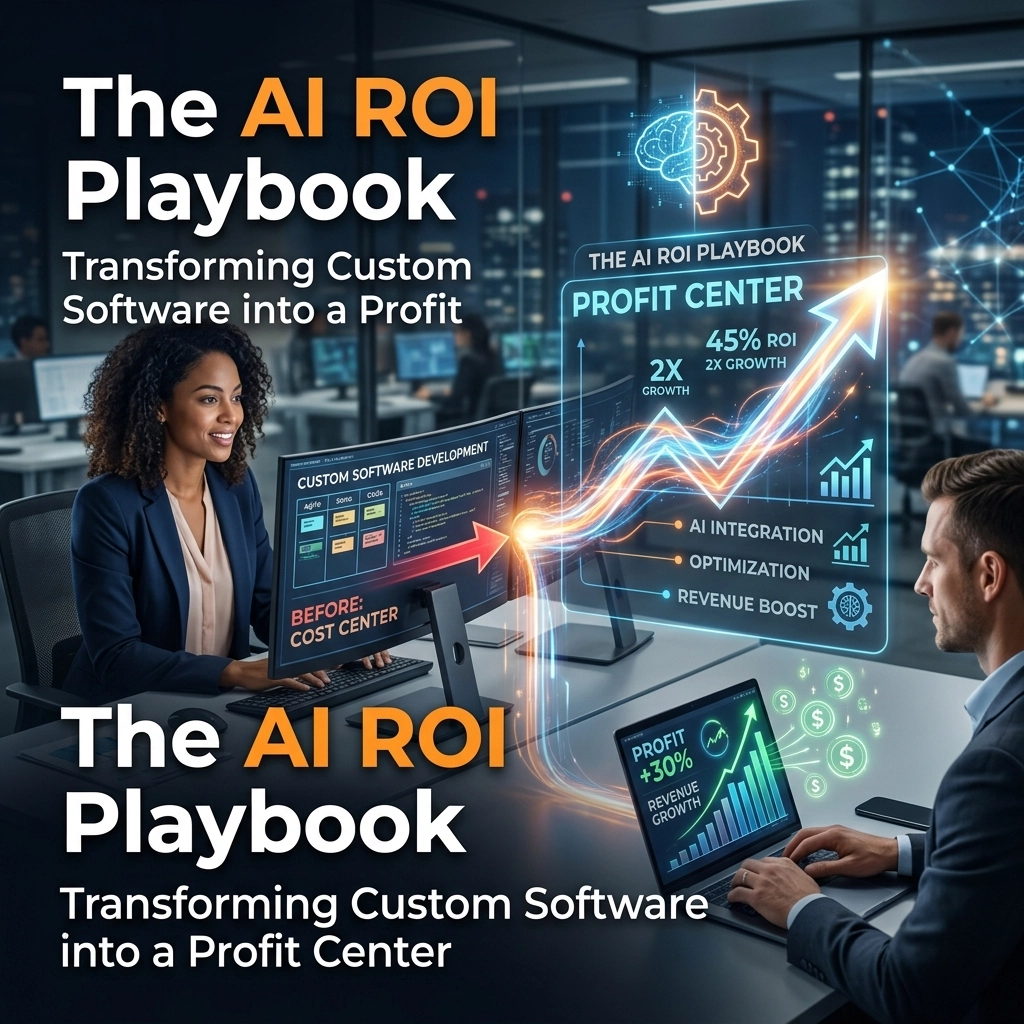
To transform your software from a cost center into a profit powerhouse, you need a repeatable playbook. At NV Seeds, we utilize a structured framework to ensure our clients aren't just building: they’re winning.
1. SEE: The Ecosystem Audit
Before you can build the future, you have to admit where the past is holding you back. This involves a deep dive into your current tech stack to identify "bottleneck silos." (Witty but true note: If your "AI strategy" depends on an Excel sheet from 2018, we need to talk.)
2. MEASURE: Instrumentation is Everything
You can't manage what you don't track. We move beyond simple "cost-per-task" metrics and look at:
- Agentic Resolution Rate: How many tasks is your AI finishing without human intervention?
- Cycle Time Reduction: How much faster are you shipping features? (We’re seeing 40% faster cycles with the right enterprise software solutions).
- Net Present Value (NPV): Calculating the long-term value of the data your software is collecting.
3. DECIDE: The 30-Day Sprint
Don't commit to a million-dollar project based on a slide deck. We run structured 30-day pilots to generate "decision-quality data." If the ROI isn't visible in 30 days, we pivot. Period.
4. ACT: Scale or Kill
If it works, we hire developers to scale it enterprise-wide. If it doesn’t, we kill it and move the resources to a higher-impact area.

High-Impact Use Cases for 2026
Where is the money actually hiding? It’s not in "generic chatbots." It’s in specialized, deeply integrated AI agents.
Customer Service Transformation
We’ve moved past simple FAQ bots. Modern Gen-AI agent development allows for systems that can handle complex multi-step refunds, technical troubleshooting, and upsells.
- The Bottom Line: We’ve seen a 40% increase in resolution rates within 60 days for our enterprise clients.
Intelligent SaaS Platforms
When we handle SaaS platform development, we aren't just building dashboards. We’re building dynamic pricing engines and predictive churn models that proactively save customers before they even know they’re unhappy.
- The Bottom Line: This transforms software from a utility into a proactive revenue-protection tool.
Accelerated Software Development
By integrating AI into the development lifecycle itself, our dedicated teams are achieving 25-35% higher code coverage with automated test generation. This isn't just "coding faster"; it's building more robust systems for less money.
Your 2026 AI ROI Playbook Checklist
If you are a CTO, Product Owner, or Founder, here is your "Cut-to-the-Chase" action plan:
- Audit the Burden: Calculate how much your team spends "babysitting" your current AI implementations. If the operational cost is higher than the manual cost, kill the project.
- Define "Success" Metrics: Before starting any custom software development, define exactly what $1 of investment should return in 12 months.
- Focus on "Unlocking," Not just "Saving": Cost savings are great, but the real ROI in 2026 comes from capability unlocking: doing things your business literally couldn't do two years ago.
- Modernize the Core: AI is only as good as the data it sits on. Use digital transformation consulting to clean up your legacy architecture before trying to automate it.
- Pick the Right Partner: Don't hire a "body shop." Hire a strategic partner who understands the financial implications of every architectural choice.
Frequently Asked Questions
How long does it take to see actual ROI from custom AI software?
With a focused pilot, you should see "leading indicators" of ROI (like time saved or error reduction) within 30 to 60 days. Financial ROI usually hits the balance sheet within 6 to 9 months of full-scale deployment.
Is it cheaper to buy off-the-shelf AI tools or build custom?
Off-the-shelf is cheaper for generic tasks (like writing emails). However, for core business logic, custom software development provides a 10x higher ROI because you own the IP and the data loop, which prevents competitors from simply buying the same advantage. How much does it cost to develop an app? It depends on the complexity, but the long-term value of custom ownership usually outweighs the "rent" of a SaaS tool.
What is "Agentic AI" and why should I care?
Think of regular AI like a calculator: it gives you an answer when you ask a question. Agentic AI is like an employee: it takes a goal (e.g., "Onboard this client") and carries out the necessary steps across different systems to get it done. This is where the real profit transformation happens in 2026.
The Inflection Point
We are at a unique moment in the history of technology. The "Golden Age of Implementation" is here. The tools are ready, the infrastructure is stable, and the business cases are proven.
The only question is: Is your software a line item on your expense report, or is it a powerhouse on your revenue statement?
At NV Seeds, we don't just write code. We build profit centers. Whether you need a dedicated team to modernize your stack or high-level digital transformation consulting, we are here to ensure your vision results in measurable growth.
Ready to stop guessing and start measuring? Let’s talk.
Leave a Reply