
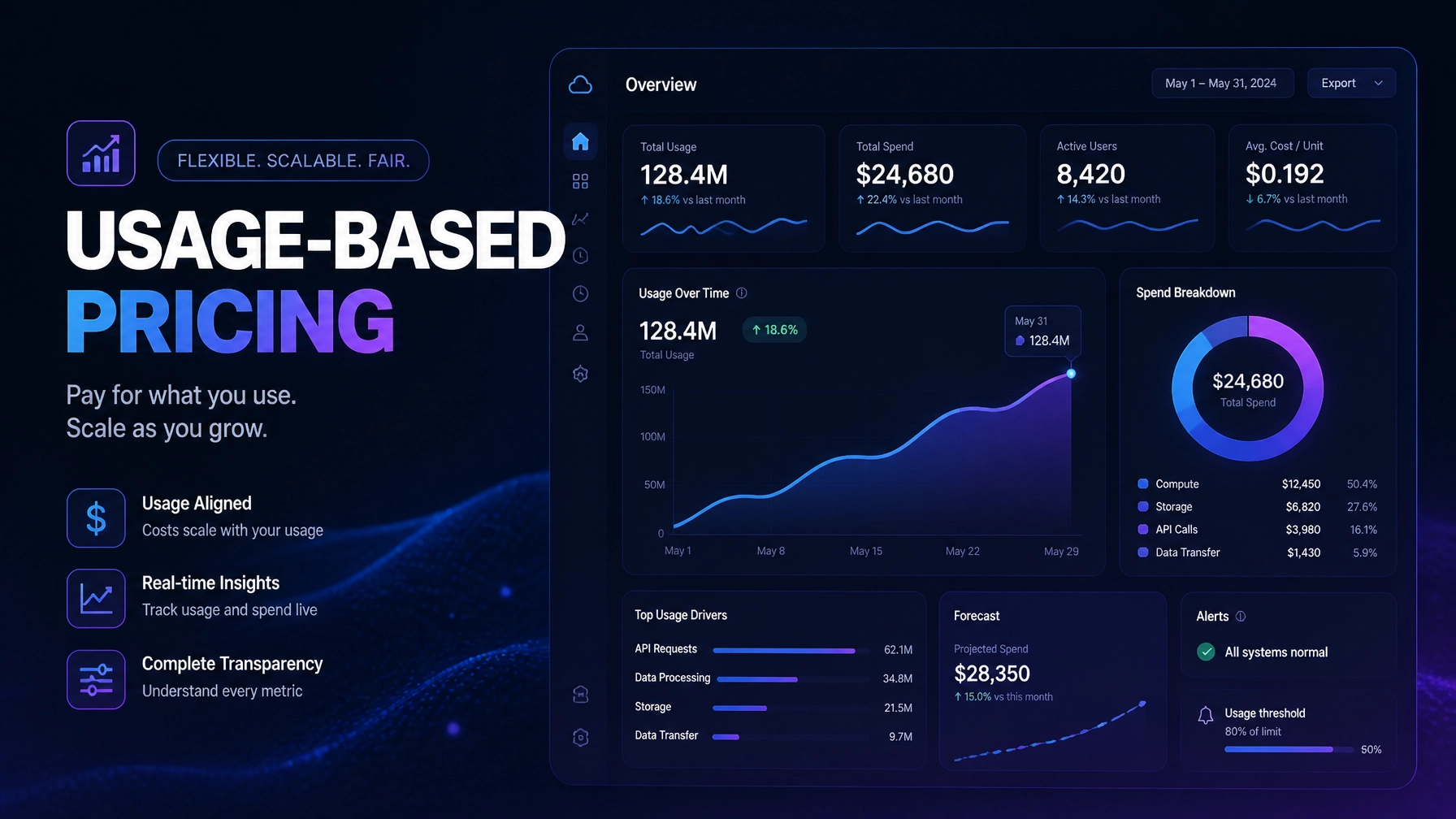
The year is 2026, and the "Per-User/Per-Month" subscription model is officially a relic of the past. If you’re still trying to sell 50 seats of a platform to a company that only uses five of them, you’re not just losing customers, you’re losing ground to competitors who have mastered the art of Usage-Based Pricing (UBP).
Let’s be real: Subscriptions were a great "Phase 1" for SaaS. They were predictable, easy to bill, and even easier for CFOs to hate. But in an era where AI-driven features consume compute cycles like a hungry teenager, and APIs are the lifeblood of business, a static seat price makes zero sense.
At NV Seeds, we’ve watched this shift happen in real-time across the 500+ projects we’ve delivered. The "Inflection Point" has passed. Today, 74% of SaaS providers have moved to a usage-based or hybrid model. If you’re building your next platform on a legacy subscription mindset, you’re building a dinosaur.
The Evolution of SaaS Billing: A Fun Historical Lap
Before we dive into the "how," let's look at how we got here:
- Phase 1: The License Era (Pre-2010): You bought a CD, installed it, and prayed for an update in three years.
- Phase 2: The Subscription Renaissance (2010-2023): "The Seat is King." You paid $20/month whether you used the tool for 100 hours or 10 minutes.
- Phase 3: The Consumption Powerhouse (2024-Present): Value is decoupled from users and tied to actual outcomes, API calls, tokens, records processed, or data gigabytes.
(Witty but true note: In 2026, charging by the seat is essentially the business equivalent of paying for a gym membership and the gym owner charging you more just because you brought a friend to hold your towel.)
1. Scalability: Why Your Legacy Infrastructure is Your Biggest Risk
Transitioning to UBP isn't just a marketing change; it's an engineering overhaul. In a standard subscription model, your load is relatively predictable. In a usage-based world, your infrastructure needs to be as elastic as a rubber band.
When you charge per API call, a sudden spike in customer usage is a double-edged sword: it’s great for revenue, but it’s a nightmare for cloud infrastructure services that aren't built to scale instantly.
The Infrastructure Requirements for 2026:
| Feature | Legacy Subscription | Usage-Based SaaS |
|---|---|---|
| Scaling | Horizontal (Manual/Scheduled) | Hyper-Elastic (Automated) |
| Data Flow | Batch Updates | Real-Time Event Streams |
| Monitoring | Performance Metrics | Billing + Performance Metrics |
| DB Strategy | Relational (SQL) | Hybrid (SQL + Time-Series) |
To survive the bursty nature of consumption (especially if you're integrating AI), you need an event-driven architecture. Think of it like a kitchen's ingredient delivery: in the old days, you’d order 50 onions every Monday. Now, you need a system that delivers an onion the exact millisecond a chef starts chopping.
2. Real-Time Metering: The Heart of the Machine
The single most common reason UBP transitions fail is metering inaccuracy. If you overbill, you lose trust. If you underbill, you lose your shirt.
In custom software development, we now treat "The Metering Engine" as a first-class citizen. You can't just tack it onto your billing code. You need a dedicated, low-latency service that can handle millions of events without blinking.

The Technical "Gotchas":
- Idempotency: If a network blip sends the same "usage event" twice, your system must be smart enough not to charge the customer twice.
- Latency vs. Accuracy: You need to check if a user has "credits" left on every single request. If that check takes 200ms, your SaaS platform development will feel sluggish and broken.
- Backfill: Sometimes events arrive late. Your engine must be able to "rewrite history" and update the billing period correctly without crashing the ledger.
3. UX: Solving the "Sticker Shock" Problem
People hate surprises on their credit card statements. If you move to usage-based pricing without a stellar User Experience (UX), your support team will spend 90% of their time explaining bills.
Transparency is the new currency. Your dashboard needs to show Real-Time Cost Tracking.

The 2026 UX Playbook for UBP:
- Spend Caps & Guardrails: Let customers set a "hard stop" at $500/month. It builds massive trust.
- Predictive Budgeting: Use AI (ironically) to tell the customer: "Hey, at your current rate, you’ll hit $1,200 by the 20th. Want to optimize?"
- Unit-Value Clarity: Don't just say "10,000 units." Explain that those units saved them 40 hours of manual labor.
Case Study: Project Volt
One of our recent clients, a global logistics firm, was struggling with their SaaS platform's profitability. They were charging a flat $2,000/month per warehouse. Some warehouses processed 100 shipments; others processed 100,000. The high-volume users were costing them more in server fees than they were paying in subscriptions.
NV Seeds stepped in to lead their digital transformation. We:
- Re-architected their backend into a serverless event-stream.
- Implemented a custom-built real-time metering engine using Kafka and ClickHouse.
- Developed a "Pay-per-Shipment" hybrid model ($500 base + $0.10/shipment).
The Result?
- ROI: The client saw a 22% increase in average revenue per account (ARPA) within 4 months.
- Customer Satisfaction: Small warehouses loved the lower entry price, and large enterprises appreciated the "pay-for-what-we-get" transparency.
- 98% Retention: By aligning cost to value, the "cost-cutting" conversations with CFOs disappeared.
How NV Seeds Built This Future
We don't just write code; we architect business growth. With a 98% client satisfaction rate and presence in over 20 countries, we’ve seen the "seat-based" model die a slow death. Our agile software development methodology ensures that when you're ready to switch to UBP, your infrastructure is ready to handle the load on day one.
Whether you need a custom web app or a global enterprise solution, our team of experts is ready to transform your vision into a scalable, profit-driving reality.
Your Usage-Based Pricing Playbook
Ready to make the jump? Here is your "Cut-to-the-Chase" checklist:
- Identify the "Value Metric": What is the one thing your customer does that creates the most value? (API calls, storage, messages?)
- Audit Your Cloud Infrastructure: Can your current DB handle a 10x spike in write-events for metering?
- Build the "Safe Stop": Implement spending limits and automated alerts before you launch.
- Run a Shadow Bill: For 30 days, calculate what customers would have paid under UBP vs. their current sub. Don't guess, use data.
FAQ: The Questions You’re Asking Your CTO Right Now
Q: Isn’t usage-based pricing harder to forecast for revenue?
A: Initially, yes. It looks like a "heartbeat" monitor rather than a straight line. However, over the long term, it is much more resilient. You grow with your customers. When they succeed, you succeed.
Q: What if our customers hate the unpredictability?
A: This is why the Hybrid Model is king in 2026. Give them a "Base Subscription" that includes a certain amount of usage. It provides the predictability they want with the scalability you need.
Q: Do I need a third-party billing tool?
A: Tools like Stripe and Stigg are great for the "Rating" and "Invoicing" parts. However, you will almost always need a custom-built "Metering" layer to sit inside your product to ensure zero-latency enforcement.
Q: How long does it take to transition?
A: A full architectural migration typically takes 3 to 6 months. But with NV Seeds' proven track record of 500+ successful projects, we can often accelerate that timeline using our modular SaaS blueprints.
Ready to build the last SaaS platform your customers will ever need?
Contact NV Seeds Today and let’s turn your vision into code.
Leave a Reply