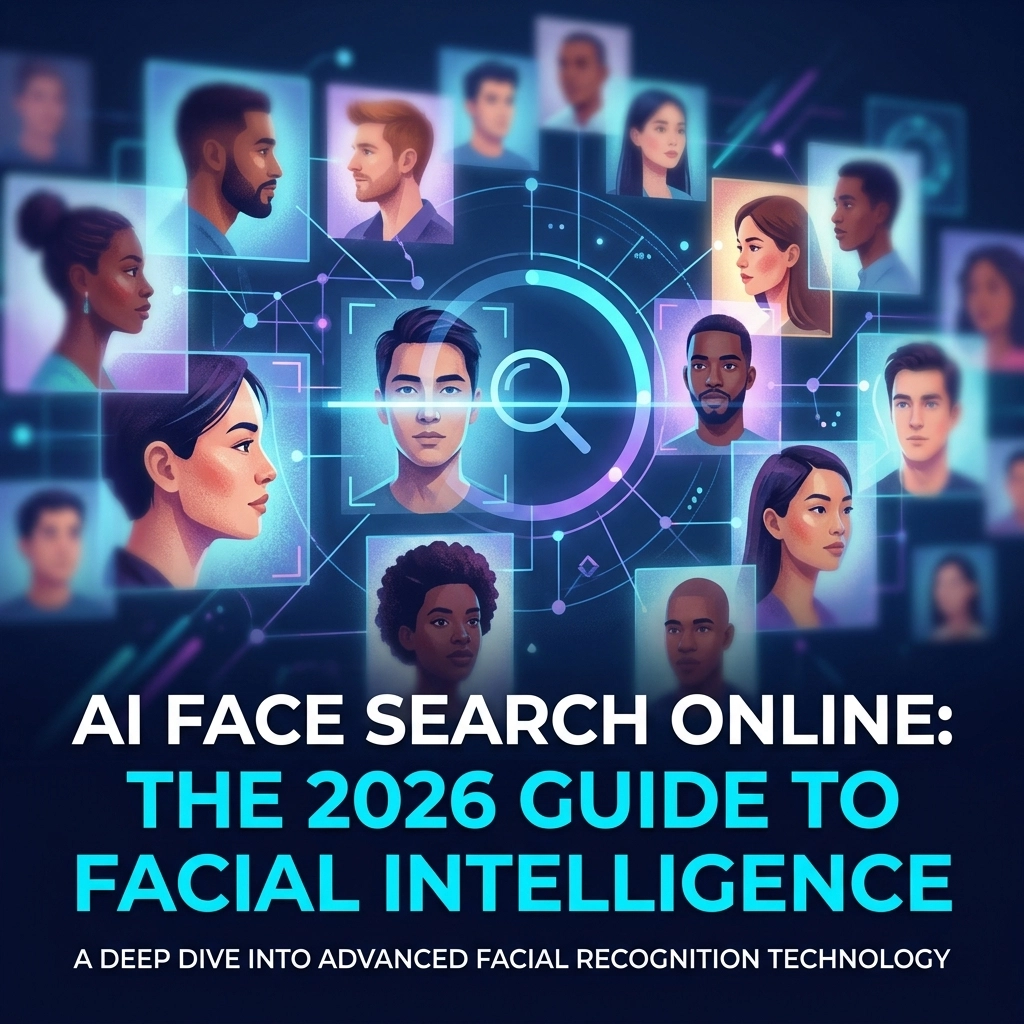
Let’s be honest: the days of typing "Who is the guy in the blue shirt at the 2024 tech mixer?" into a search engine and hoping for a miracle are officially over. We’ve entered the era of Facial Intelligence (FI). In 2026, AI face search online isn't just a party trick or a tool for private investigators; it’s the backbone of enterprise security, frictionless hospitality, and personal brand protection.
At NV Seeds, we’ve seen this shift firsthand. As a custom software development powerhouse, we’ve moved from building simple "image matchers" to architecting complex neural networks that understand depth, skin texture, and even emotional micro-expressions. If you’re not thinking about how facial search impacts your business, you’re already behind the curve.
The State of the Union: Facial Recognition in 2026
We aren’t in Kansas anymore. As of early 2024, the global facial recognition market was a fraction of what it is today. Now, in April 2026, the market has ballooned to a $9 billion powerhouse. What’s more interesting is the composition of that spend: 54% of the market is now dominated by software, proving that while cameras are the eyes, the AI "brain" is where the real value lies.
Industry adoption has hit an inflection point. Take the hospitality sector, for example. Recent data shows that 74% of hotel operators now expect biometric staff ID and guest check-ins to be the standard. We’re moving toward a "frictionless world" where your face is your boarding pass, your credit card, and your office key.
Beyond the Search Bar: How Facial Intelligence Works
When you perform an AI face search online today, you aren't just "comparing pictures." Modern systems utilize a multi-stage pipeline that would make 2020-era developers weep with envy.
- Normalization: The AI takes your grainy, poorly lit selfie and creates a 3D mathematical map.
- Feature Extraction: It identifies 50+ unique facial landmarks (the distance between your pupils, the curve of your jawline, the depth of your eye sockets).
- Vectorization: These landmarks are converted into a "faceprint": a string of numbers that is unique to you.
- The Search: This faceprint is compared against billions of indexed images in milliseconds.
For businesses looking to integrate this, the "off-the-shelf" solutions often fall short. That’s why many companies choose to hire dedicated developers to build proprietary models that respect privacy while maintaining 99.9% accuracy.

Real-World Tools Dominating the Market
If you’re looking to see what "best-in-class" looks like right now, look no further than these two titans:
- Facia.ai: The gold standard for liveness detection. In an era of high-quality deepfakes, Facia.ai ensures that the person on the other side of the camera is a living, breathing human, not a high-res photo or a 3D mask.
- Alcatraz.ai: Taking enterprise access control to the next level. They’ve pioneered "autonomous access," where the system learns and adapts to the environment, making traditional keycards look like ancient relics.
[SCREENSHOT: A real-time liveness detection dashboard showing 'Real' vs 'Spoof' analysis with confidence scores and heatmaps]
The 2026 AI Face Search Toolbox
Cut through the noise. These are the platforms businesses are actually evaluating in 2026 when face search moves from a novelty to an operational engine.
Quick Comparison Table
| Tool | Best For | Enterprise Angle | Watch-Out |
|---|---|---|---|
| PimEyes | Deep-web tracking and copyright monitoring | Useful for executive brand monitoring and image misuse discovery | Public-web search use still demands strict internal policy controls |
| FaceCheck.ID | Identity verification and OSINT | Strong fit for fraud review workflows and investigation teams | Requires careful governance for compliance-sensitive use cases |
| AIFaceSearch.io | Smart filtering and result organization | Helps analysts move faster with People vs. Duplicates separation | Better as part of a workflow than a complete enterprise stack |
| Reversely.ai | Hybrid face + reverse image search | Great when you need both facial similarity and general image matching | Needs tuning on the process side to reduce noisy results |
| Social Catfish | Impersonation evidence gathering and risk screening | Useful for trust & safety teams, romance scam checks, and fraud escalation | Best used with a human-in-the-loop review model |
| Paravision Search | Massive enterprise-scale matching | Built for high-volume environments with millions of records | Enterprise deployments need serious architecture planning |
1) PimEyes
Think of PimEyes as your digital bloodhound. It’s particularly effective for deep-web tracking and copyright monitoring, making it useful when your company needs to see where executive headshots, campaign images, or branded likenesses are being reposted without permission.
For enterprise teams, that matters more than it sounds. A stolen founder photo on a fake investment profile can snowball into reputation damage fast. PimEyes helps you spot the smoke before the fire turns into a compliance bonfire.
2) FaceCheck.ID
If your use case leans toward high-accuracy identity verification and OSINT, FaceCheck.ID is usually on the shortlist. This is the tool investigators, trust teams, and fraud analysts often gravitate toward when they need a stronger confidence layer.
In plain English: when your team has to answer, "Is this person who they say they are, or are we being played?" this is one of the sharper knives in the drawer.
3) AIFaceSearch.io
AIFaceSearch.io stands out because of its smart filtering, especially how it organizes results into People vs. Duplicates. That sounds like a small UI detail. It isn’t. It’s the difference between your analysts finding the right lead in minutes or drowning in visual spaghetti.
For businesses processing high volumes of profile images, support escalations, or moderation cases, cleaner filtering directly improves turnaround time and lowers cost-per-review.
4) Reversely.ai
Reversely.ai is the hybrid machine in this lineup. It blends facial recognition with standard reverse image search, which makes it useful when the problem isn’t just "find this face," but "find this face, this image, and all the weird copies floating around the web."
That hybrid approach is gold for fraud teams and brand protection programs, because impersonation rarely travels alone. It usually drags edited photos, scraped profile pictures, and reposted marketing assets along for the ride.
5) Social Catfish
Social Catfish is built for risk screening and gathering evidence of impersonation. It’s a practical tool when your trust & safety team needs to validate whether a suspicious profile is fake, recycled, or part of a broader scam pattern.
Witty but true: if your platform has user profiles, eventually someone will show up wearing a borrowed face like it’s a Halloween costume. Social Catfish helps you catch that before your customers do.
6) Paravision Search
At the enterprise end of the spectrum, Paravision Search is the heavyweight. This is the pick for massive matching environments where you’re comparing against millions of records, not just a few thousand profile photos in a tidy dashboard.
If your operation spans airports, corporate campuses, hospitality chains, or national-scale identity systems, Paravision is built for that sort of industrial-grade load. It’s less "search box" and more "facial intelligence engine room."
Toolbox Playbook
If you’re choosing among these tools, use this quick filter:
- Pick PimEyes when your biggest concern is image misuse, copyright monitoring, or executive brand protection.
- Pick FaceCheck.ID when you need identity verification and OSINT support.
- Pick AIFaceSearch.io when your team needs cleaner filtering and faster analyst workflows.
- Pick Reversely.ai when you need both face matching and standard reverse image discovery.
- Pick Social Catfish when impersonation risk screening is the priority.
- Pick Paravision Search when you need enterprise-scale matching across massive datasets.
High-Impact Use Cases for Enterprises
This is where AI face search stops being a cool demo and starts acting like a business multiplier.
Fraud & Safety
In dating apps, fintech products, lending platforms, and marketplaces, impersonation is expensive. It burns trust, triggers chargebacks, and invites regulatory headaches. With AI face search, you can instantly flag impersonators, compare suspicious profile photos against known fraud patterns, and route edge cases to human reviewers.
Bottom line: fewer fake accounts, faster investigations, and lower fraud-loss per incident.
Retail & Hospitality
This sector is having its own biometric renaissance. Hotels are using face-based systems to automate VIP check-ins, personalize guest experiences, and streamline staff access. Retailers and service businesses are also applying facial verification to staff time-tracking, reducing buddy punching and shaving admin overhead.
It’s the equivalent of replacing a clipboard with a control tower.
Corporate Security
Keycards had a good run. But in 2026, sub-second facial authentication is pushing physical access control into a new phase. You can move beyond badges, PINs, and shared credentials toward a smarter perimeter where entry decisions happen in real time.
That means faster throughput, fewer credential-sharing loopholes, and a much stronger audit trail for sensitive zones.
Brand Protection
For leadership teams, public speakers, founders, and visible executives, likeness misuse has become a real business problem. AI face search gives you a way to scan the web for unauthorized use of leadership imagery, fake adviser pages, cloned social profiles, and shady promotional materials.
In other words, you stop treating reputation risk like a PR issue and start managing it like a security issue.
Enterprise Use Case Checklist
Before you deploy, ask:
- Are you solving fraud, access control, customer experience, or brand protection?
- Do you need real-time matching or investigative search?
- What is your acceptable false positive threshold?
- Will results trigger automation, manual review, or both?
- How will you log consent, retention, and deletion requests?
Case Study: The "Keyless Campus" Revolution
Last year, a major tech campus in Northern Europe approached us at NV Seeds. They were struggling with "tailgating" (unauthorized people following employees through secure doors) and a slow morning "bottleneck" where 2,000 employees were trying to swipe badges simultaneously.
The Solution: We implemented a custom-built AI facial authentication system integrated with their existing HR stack.
The Results:
- Tailgating Incidents: Reduced by 60% within the first month.
- Throughput: Improved by 3x. Employees no longer had to stop; they simply walked toward the door, and it opened.
- ROI: The system paid for itself in 14 months through reduced security personnel costs and reclaimed "lost time" during shift changes.
This wasn't just "buying an app"; it was a deep-dive custom software development project that tailored the AI to the specific lighting and movement patterns of that campus.
Why "Off-the-Shelf" is a Security Risk
You might be tempted to use a free AI face search online tool and call it a day. Don't. For a business, using public search tools to handle sensitive biometric data is like leaving your vault door open and inviting the neighbors to watch the "security" footage.
When we work with clients at NV Seeds, we focus on Privacy by Design. This means:
- On-Premise Processing: Data never leaves your secure environment.
- Encryption at Rest: Even if a database is breached, the "faceprints" are useless strings of numbers that can't be reversed into images.
- Integration: Seamlessly connecting facial data with your payroll or CRM.
[SCREENSHOT: An enterprise HR dashboard from NV Seeds integrating facial clock-in data with real-time payroll and attendance analytics]
The 2026 AI Face Search Playbook
If you’re ready to implement facial intelligence, follow this "cut-to-the-chase" guide:
- Define Your "Why": Are you trying to stop fraud, or just make check-in faster? Your goal dictates the tech (e.g., Liveness Detection vs. Simple Matching).
- Audit Your Hardware: 2026 AI requires high-fidelity input. If your cameras are from 2018, the best software in the world won't save you.
- Legal First, Code Second: Ensure you are compliant with local laws. The "Wild West" days of facial recognition are over.
- Choose Your Team: Don't settle for generalists. Hire dedicated developers who understand the nuances of computer vision and GPU acceleration.
How NV Seeds Builds Your Facial Intelligence
This is the part most blogs skip. Tools matter, yes. But enterprise advantage rarely comes from plugging in one API and calling it innovation. It comes from building the right system around the model, the workflow, and the compliance layer.
That’s where NV Seeds comes in.
Custom Software Development
We don’t just wire up third-party APIs and hope for the best. We build custom portals, dashboards, and facial intelligence workflows tailored to your exact security, operations, and customer-experience goals.
So if your business needs:
- a facial verification console for your fraud team,
- a visitor management portal for a secure campus,
- a biometric attendance interface for distributed staff, or
- an executive brand-monitoring dashboard,
—we can architect it from the ground up. Clean. Scalable. No duct tape.
Secure Integration
Facial intelligence gets valuable when it talks to the rest of your business stack. We handle secure integrations with systems like:
- HRIS platforms for employee identity and attendance
- Payroll systems for verified time-tracking
- CRM tools for customer recognition workflows
- Access control software for doors, gates, and restricted zones
- Case management tools for fraud and investigation teams
That means your biometric workflows don’t live on an island. They become part of a bigger operating system for your business.
Privacy-First Architecture
Biometric systems without compliance discipline are a lawsuit wearing a blazer. We build with privacy-first architecture so your deployment aligns with strict standards tied to GDPR, BIPA, and CCPA.
Our engineering approach includes:
- consent-aware data flows,
- encryption at rest and in transit,
- retention and deletion controls,
- audit logs,
- role-based access, and
- data minimization from day one.
Translation: you can innovate without stepping on a legal landmine.
Specialized AI Engineering
This is where the serious engineering starts. Our team can fine-tune and optimize facial models to perform better in the real world, not just in a glossy product demo.
We help businesses tackle problems like:
- demographic bias reduction
- low-light and variable-angle performance
- spoof resistance and liveness improvements
- latency tuning for real-time environments
- matching accuracy across diverse datasets
If you want to lead instead of follow, the move is simple: hire dedicated developers from NV Seeds who know how to turn facial intelligence from a buzzword into a working business asset.
NV Seeds Build Playbook
To move from idea to deployment, we typically recommend this sequence:
- Map the use case — fraud detection, access control, hospitality, or brand protection.
- Design the data architecture — where images, embeddings, logs, and permissions live.
- Choose the model strategy — API-first, custom-trained, or hybrid.
- Integrate with your stack — HRIS, payroll, CRM, security, and analytics.
- Validate compliance — consent, retention, deletion, and auditability.
- Pilot in the wild — test for lighting, edge cases, bias, and operational throughput.
- Scale with confidence — expand only after the metrics prove it.
FAQ: Clearing the Air on Facial Intelligence
Q: Is "liveness detection" really necessary?
A: In 2026, it's mandatory. Photo-spoofing is a script-kiddie level trick now. If your system can't tell the difference between a real face and a high-def 8K screen, you don't have security: you have a facade.
Q: How do we handle regulations like BIPA and GDPR?
A: You need clear consent and a "Right to be Forgotten" protocol. We build these features directly into the architecture, ensuring that if a user asks for their biometric data to be wiped, it actually happens across all nodes.
Q: What about demographic bias in AI models?
A: This is a major hurdle. At NV Seeds, we use diverse training datasets and regular "bias audits" to ensure our models perform equally well across all ethnicities and age groups. It's not just a moral choice; it's a technical necessity for accuracy.
Q: Can we use facial search for remote teams?
A: Absolutely. It’s the ultimate tool for "Proof of Presence." Many of our clients who hire dedicated developers use facial check-ins to secure their remote dev environments and prevent account sharing.

The Bottom Line
AI face search online has evolved from a niche investigative tool into a fundamental pillar of modern digital infrastructure. Whether you're securing a campus, streamlining a hotel, or building the next great SaaS platform, facial intelligence is the "Infinity Stone" of your tech stack.
Ready to stop guessing and start building? At NV Seeds, we turn "Vision" into "Code." Whether you need a dedicated team to scale your existing AI or a full-scale custom software development partner, we’re here to help you lead the charge in 2026 and beyond.
Contact us today to see how we can bring Facial Intelligence to your business.
Leave a Reply