It’s April 2026, and if your tech stack is still relying on a single, monolithic database to handle everything from user logins to AI-driven recommendations, you’re not just behind the curve, you’re likely hitting a performance ceiling that’s costing you money.
The era of the "General Purpose Database" isn't exactly dead, but it has certainly been demoted. In the high-stakes world of enterprise software solutions, we’ve reached an inflection point where the complexity of data requires a specialized approach. We call this "Polyglot Persistence," and it’s no longer a luxury for Silicon Valley giants; it’s a requirement for any business scaling a modern SaaS platform.
At NV Seeds, we’ve seen dozens of companies struggle with latency and system crashes because they tried to force-feed "unstructured" AI data into a "structured" SQL box. It’s like trying to use a master ledger to store every sticky note, every customer’s mood, and every financial transaction simultaneously. It’s messy, it’s slow, and it eventually breaks.
Here is why your business needs a three-database strategy right now to ensure agile software development and long-term scalability.
The Evolution of the Data Stack: A Brief History
To understand where we are, we have to look at how we got here.
- Phase 1: The SQL Monolith (1990s–2010s): One database to rule them all. If it didn't fit in a row and column, you made it fit.
- Phase 2: The NoSQL Rebellion (2010s–2022): The rise of big data and real-time feeds. We realized we needed speed and flexibility, leading to the birth of document and key-value stores.
- Phase 3: The Intelligence Era (2023–Present): The "Renaissance" of AI. Suddenly, we need to store "vectors", mathematical representations of meaning, to power LLMs and personalization.
The 2026 Data Snapshot
Let’s skip the fluffy benchmark theater and get to the useful stuff. The 2026 state of data architecture is loud, and it is pointing in one direction: specialization wins.
Here’s the quick snapshot:
- Only 16% of enterprises now rely on a single database, down from 26% last year
- PostgreSQL leads developer adoption at 55.6%, which tells you the relational layer is still the bedrock
- AI adoption in database management jumped from 15% to 44% in just 12 months, which means intelligent automation is no longer a side experiment
That is the inflection point. Enterprises are not abandoning SQL. They are building around it with faster and smarter layers.
| Metric | 2025 | 2026 | What it signals |
|---|---|---|---|
| Enterprises using a single database | 26% | 16% | Monolith-first architecture is shrinking fast |
| PostgreSQL developer adoption | — | 55.6% | SQL remains the source-of-truth powerhouse |
| AI adoption in DB management | 15% | 44% | Automation, tuning, and observability are entering the mainstream |
Bottom line: you are not watching a trend. You are watching a migration wave. The companies that move early get cleaner scale, better performance, and fewer 2 a.m. production fire drills.
1. The One-Database Trap
Let’s cut past the vague architecture talk. When an enterprise runs everything on one database, that database becomes the office printer, filing cabinet, receptionist, and security desk all at once. It works. Until everyone shows up at 9:00 AM.
In the early stages, a single Relational Database (RDBMS) like PostgreSQL or MySQL feels efficient. You keep users, billing, reporting, product data, session state, search metadata, and maybe even some AI-adjacent content in one place. Clean in theory. Chaotic in production.
Here’s what usually happens:
- Bottlenecks pile up: Transaction-heavy workloads compete with analytics, dashboards, and customer-facing reads.
- Complex queries slow everything down: A few monster
JOINs can turn your production database into a traffic jam with SQL syntax. - Scaling gets expensive fast: Instead of optimizing by workload, you keep upgrading one giant machine.
- It becomes a single point of failure: If that one database goes down, your product doesn’t limp. It face-plants.
This is why so many teams hit a wall during growth. The database that once felt like a sturdy warehouse starts behaving like an overstuffed closet with the door held shut by hope.
Why enterprises outgrow the one-database model:
- Transactional and analytical workloads clash
- Latency rises as schema complexity expands
- Release cycles slow down because every change touches the same core system
- Resilience suffers because too much depends on one engine
For custom software development, we still treat SQL as the source of truth for critical records. But asking it to be truth, speed layer, and AI memory all at once is like hiring your CFO to also run customer support and pack warehouse boxes.
2. The Two-Database Transition
So what does a smart enterprise do next? It graduates. Usually into a SQL + NoSQL model.
This is the classic second phase of modern architecture. You keep SQL for financial transactions, permissions, billing, and relational data. Then you add NoSQL systems like MongoDB, Cassandra, or Redis for caching, document storage, real-time feeds, session data, or flexible product metadata.
That move is a big upgrade.
If the relational database is your ledger, the NoSQL Database is your high-speed prep station. It handles the fast-moving, constantly changing parts of your application without forcing every request through a maze of normalized tables.
What improves in the two-database model:
- Better speed: Redis and similar systems slash latency for hot data.
- More flexible schema design: Great for SaaS platform development where requirements keep shifting.
- Easier horizontal scaling: NoSQL systems are built to spread across infrastructure more naturally.
- Cleaner workload separation: SQL handles integrity; NoSQL handles velocity.
Modern users expect sub-millisecond response times. If your app is fetching a social feed, "last seen" status, or a chunky JSON configuration object, you should not be firing off a twelve-table relational query like it’s still 2014.
(Witty but true: relying only on SQL for real-time product behavior is like using a forklift to deliver a coffee.)
But here’s the catch: SQL + NoSQL still leaves a major blind spot. It gives you structure and speed, but not semantic understanding.
That means:
- Your search still depends heavily on keywords
- Your chatbot memory is brittle or bolted on awkwardly
- Your recommendation engine struggles with intent, similarity, and context
- Your AI features often require hacks instead of native architecture support
In other words, the two-database transition solves yesterday’s scaling problem, but not tomorrow’s intelligence problem.
3. The Triple-Database Powerhouse
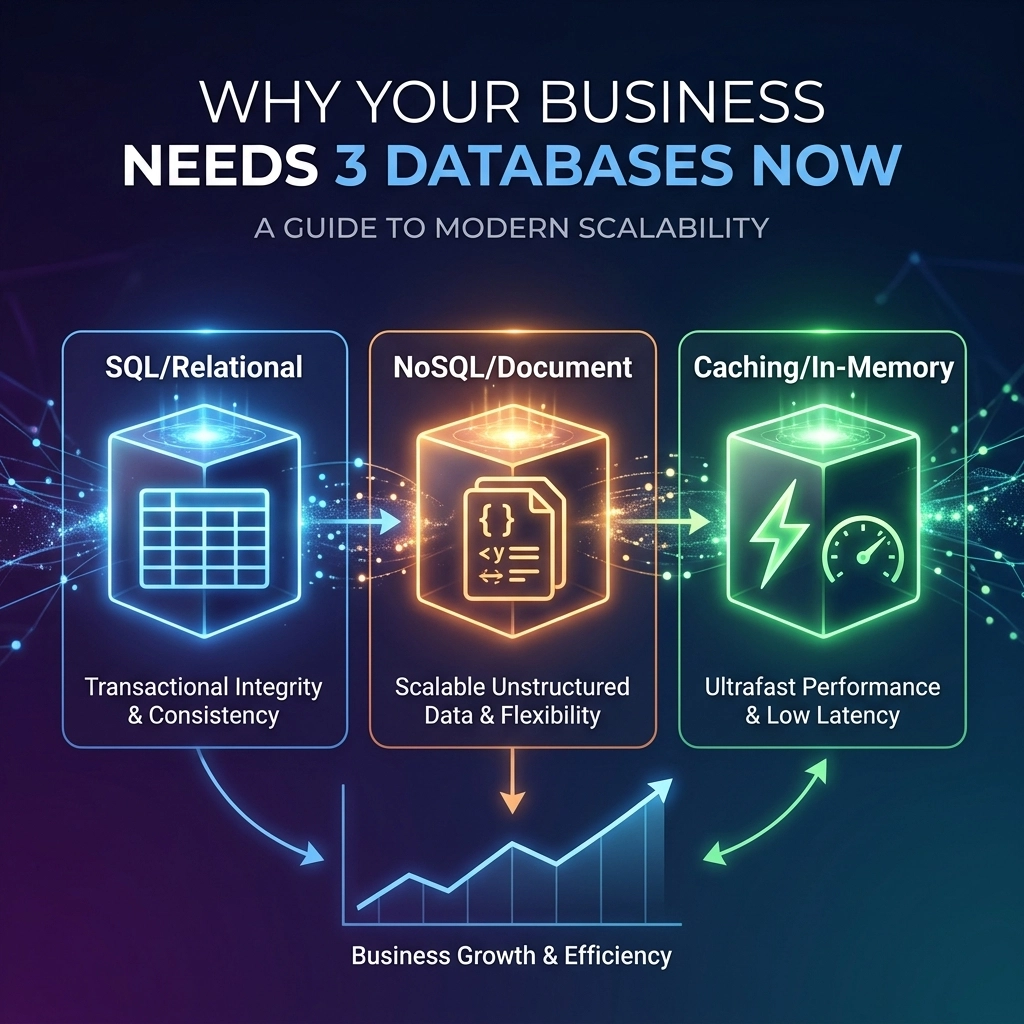
This is where modern enterprises have landed in 2026: Relational + NoSQL + Vector. Not because it sounds trendy, but because each database handles a fundamentally different job better than the others ever will.
Think of it as a specialized operating trio:
- Relational Database: accuracy, consistency, transactions, permissions, reporting
- NoSQL Database: speed, flexibility, caching, session state, event-heavy workloads
- Vector Database: meaning, similarity search, AI memory, semantic retrieval, personalization
This is the setup that turns a merely scalable platform into an intelligent one.
Relational Database: Your Source of Truth
Even now, the Relational Database (RDBMS) like PostgreSQL or MySQL remains the bedrock of your architecture. Why? Because integrity is non-negotiable.
When it comes to financial transactions, user accounts, and billing, you need ACID (Atomicity, Consistency, Isolation, Durability) compliance. You cannot afford a "glitch" where a user is charged twice or a subscription status is "eventually consistent."
Why you need it:
- Transactional Integrity: Ensuring that if a bank transfer happens, it either completes fully or doesn't happen at all.
- Complex Relationships: Mapping who owns what, who is part of which team, and how permissions propagate.
- Standardization: It’s the "ledger" of your business.
NoSQL Database: The Need for Speed
If the Relational DB is your ledger, the NoSQL Database is your high-speed prep station.
Why you need it:
- Flexible Schema: Great for SaaS platform development where user requirements change weekly.
- Low Latency: Systems like Redis act as a lightning-fast cache, keeping your most-used data in RAM rather than on a slow disk.
- Horizontal Scaling: NoSQL databases are designed to be spread across dozens of servers easily.
Vector Database: The Brain of Your AI
This is the newest member of the "Big Three." If you are building gen-ai-agent-development or any form of personalized search, a Vector Database (like Pinecone or Milvus) is mandatory.
Traditional databases search for keywords. Vector databases search for meaning.
If a user searches your e-commerce store for "something warm for a snowy hike," a SQL database looks for those exact words. A Vector database understands the intent and returns results for "thermal jackets," "merino wool socks," and "insulated boots", even if those items don't have the word "snowy" in their description.
Why you need it:
- AI Personalization: Storing user preferences as "embeddings" to provide hyper-relevant content.
- Long-term AI Memory: Giving your chatbots and AI agents a "brain" to remember past interactions without bloating your primary database.
- Semantic Search: Revolutionizing how users find information within your enterprise software solutions.
The result is a platform where each workload goes to the right engine. Your transaction history stays clean. Your app stays fast. Your AI stops feeling like duct tape on top of a database from another era.
Real-world examples of the triple-threat
This is not just a whiteboard fantasy cooked up by architects with too many sticky notes. Some of the biggest digital platforms on the planet already run on polyglot persistence because one engine simply cannot do every job well.
Take the familiar pattern used by companies like Netflix and Uber:
- SQL for billing and core transactions: subscriptions, invoices, account relationships, settlement logic
- NoSQL for operational scale: streaming metadata, session state, trip events, caching, and high-volume application reads
- Vector/Search layers for recommendations and discovery: similarity matching, semantic retrieval, ranking, and personalized experiences
The exact vendor mix changes. The architectural logic does not.
If you are serving millions of events, recommendations, or contextual searches, this three-part model is less "nice to have" and more "keep the machine from choking." SQL keeps the books balanced. NoSQL keeps the app moving. Vector/Search keeps the product feeling smart.
Why 3 is the Magic Number for Enterprises
This is the part that matters to your budget, roadmap, and sanity.
Three databases are not about excess. They are about specialization. And specialization is where performance, AI readiness, and long-term cost efficiency finally start pulling in the same direction instead of fighting each other.
1. Specialized performance beats brute-force scaling
When one database tries to do everything, you compensate with bigger servers, more replicas, and increasingly weird query tuning. That is not strategy. That is expensive damage control.
With three specialized systems, you can:
- Keep high-integrity business logic in SQL
- Route speed-sensitive workloads to NoSQL
- Route semantic and AI retrieval tasks to Vector
It’s like using a chef’s knife, a blender, and an oven for different jobs instead of trying to make dinner with a hammer.
2. AI readiness becomes native, not bolted on
This is the big 2026 shift. Enterprises are no longer asking if they need AI capabilities. They are asking why their current systems make every AI feature feel like an archaeological dig.
A vector layer gives you:
- Semantic search
- Recommendation systems based on similarity
- Retrieval-augmented generation (RAG)
- Persistent memory for AI agents and assistants
- Context-aware enterprise search across documents, tickets, and knowledge bases
Without it, your AI stack ends up improvising around infrastructure that was never designed to understand meaning.
3. Long-term cost efficiency gets better, not worse
You might be thinking, "Won't managing three databases increase my cloud infrastructure costs?"
Actually, in the long run, the opposite is usually true. When you force a single database to do everything, you have to over-provision it. You end up paying for a massive, high-CPU SQL server just to handle a few high-speed NoSQL tasks or AI retrieval workloads that belong elsewhere.
By splitting the workload, you can use smaller, more efficient instances for each task. That means better utilization, fewer performance emergencies, and less money burned on one oversized database box trying to cosplay as an entire architecture.
Here’s the bottom-line ROI:
| Feature | Single Database | 3-Database Strategy (Polyglot) |
|---|---|---|
| Performance | Degrading as data grows | Consistent and low-latency |
| Development Speed | Slowed by complex migrations | Agile software development friendly |
| AI Capabilities | Limited / Hacky | Native and powerful |
| Disaster Recovery | Single point of failure | Isolated failures; higher availability |
| Global Scaling | Extremely difficult | Seamless via edge caching and NoSQL |
| Cost Efficiency Over Time | Rising infrastructure waste | Better right-sizing by workload |
Enterprise Playbook: When to adopt the third database
If any of these sound familiar, you are already in triple-database territory:
- Your app is fast in parts, but search and recommendations still feel dumb
- Your product team wants AI features, but your data stack has nowhere to store embeddings
- Your SQL database is carrying transactional, operational, and pseudo-semantic workloads all at once
- Your cloud bill keeps rising, but user experience is not improving at the same rate
That is your cue. Not for hype. For architecture.
Case Study: The 2026 Enterprise Pivot
Here’s what this looks like when a mid-sized SaaS company stops trying to squeeze a modern product through an old MySQL monolith.
The company had grown fast. Good problem. Bad architecture. Its single MySQL database was handling billing, user profiles, admin dashboards, session-heavy reads, and a recommendation feature that was basically dragging itself uphill. Every new product feature made query plans uglier, cache misses more expensive, and cloud bills fatter.
So the team pivoted to a SQL + Redis + Pinecone stack:
- SQL kept ownership of billing, accounts, permissions, and reporting
- Redis became the low-latency cache and session layer for high-frequency reads
- Pinecone powered semantic recommendations and similarity search
The results were the kind finance and engineering both like:
- 40% reduction in cloud costs
- Sub-100ms recommendation latency
- Fewer performance spikes during traffic bursts
- Cleaner separation between transactional logic and AI-driven retrieval
That is the part people often miss. The gain was not just speed. It was architecture sanity. The team stopped over-scaling MySQL for workloads it was never built to own.
[SCREENSHOT: A performance dashboard comparing query latency before and after adding a NoSQL cache layer]
[SCREENSHOT: A vector similarity search visualization]
Architecting the Future with NV Seeds
Building a multi-database architecture is complex. It requires a deep understanding of cloud infrastructure services to ensure these systems talk to each other without creating "data silos."
At NV Seeds, we specialize in this type of digital transformation. We don't just write code; we architect systems that are built to scale. Whether you're looking for dedicated team support to overhaul your legacy system or you're starting fresh with a new SaaS idea, we ensure your data strategy is your competitive advantage, not your bottleneck.
Your Modern Scalability Playbook
Ready to make the switch? Here is how to approach it:
- Audit Your Data: Identify what is "Transactional" (SQL), what is "Transient/Fast" (NoSQL), and what is "Contextual" (Vector).
- Start with the Bottleneck: Don't migrate everything at once. If your search is slow, implement a Vector DB first. If your UI feels sluggish, add a NoSQL caching layer.
- Use Managed Services: Don't try to host these yourself. Use AWS, Azure, or specialized providers to handle the heavy lifting of maintenance and backups.
- Hire for Expertise: Multi-database environments require developers who understand data consistency patterns. If you don't have them in-house, you can hire developers who live and breathe this architecture.
Frequently Asked Questions
Isn't it harder to maintain 3 databases?
Initially, yes, there is more configuration. However, the maintenance of a single, bloated, "Frankenstein" database is actually much harder and riskier over time. Decoupling data makes it easier to update individual parts of your system without breaking the whole thing.
How much does it cost to implement this?
The cost varies based on scale, but we’ve found that the efficiency gains usually offset the licensing or hosting fees within the first 12 months. For a deeper dive into budgeting, check out our guide on how much it costs to develop an app.
How do you keep data consistent across 3 databases?
This is the question smart teams ask first, and rightly so. You do not try to force perfect synchronous consistency everywhere because that turns your architecture into wet cement.
Instead, most mature systems use patterns like:
- Saga patterns for coordinating multi-step business workflows across services
- CDC (Change Data Capture) to stream updates from the source-of-truth database into downstream systems
- Event-driven architecture so cache layers and vector indexes update asynchronously but predictably
- Clear ownership rules, where SQL remains the authority for transactional truth
In plain English: your billing record lives in SQL, your fast-changing cache lives in Redis, and your semantic representation lives in a vector store. They do not all have to behave like the same database to stay reliable.
Can I just use a Multi-Model database?
Some databases claim to do all three. While they are improving, they are often "jacks of all trades, masters of none." For true enterprise-grade performance, dedicated engines for each data type are still the gold standard in 2026.
Multi-model vs. specialized: which one is actually better?
It depends on your stage.
A multi-model database can be a practical stepping stone if you are an early-stage team that wants less operational overhead. It is simpler to manage, easier to provision, and good enough for modest scale.
A specialized stack wins when:
- Your workloads are materially different
- You need tighter performance guarantees
- AI search and recommendation quality really matter
- Infrastructure cost optimization becomes a board-level conversation
Think of multi-model as a multitool. Handy. Compact. Useful. But if you are building an enterprise product under load, specialized systems are the full workshop.
The Bottom Line
The "one size fits all" approach to data is a relic of the past. To build a resilient, fast, and AI-ready company, you need a strategy that respects the unique nature of your data.
Don't let your database be the reason your business stops growing. Let’s build something that scales. Contact us today to discuss how we can modernize your infrastructure.
Leave a Reply