
Overview
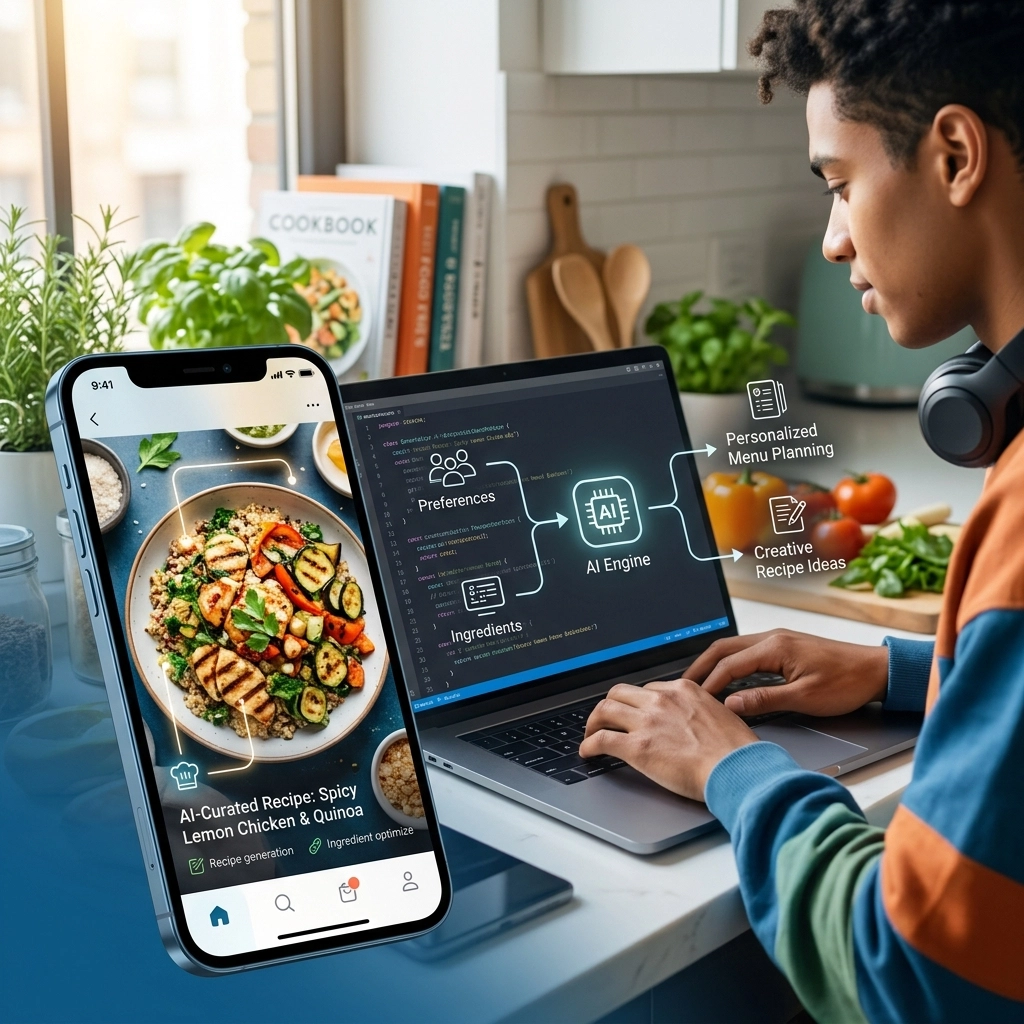
Let’s cut past the vague hype. Building a food app with Gen AI in 2026 is no longer about sprinkling a chatbot on top of a delivery flow and calling it innovation. It’s about creating a system that can understand preferences, generate recipes, process voice orders, interpret food images, and surface the right result fast enough that the experience feels effortless.
If you are planning a modern food application, Gen AI becomes the engine room behind personalization, automation, search, and engagement. Think of it like upgrading from a paper menu to a full kitchen command center. The app doesn’t just respond. It reasons, recommends, adapts, and learns from context.
This guide shows you where Gen AI actually fits, which tools matter, and how to approach development without wasting budget on flashy-but-fragile features.
Quick Snapshot
| Category | What You Need to Know |
|---|---|
| Primary Goal | Build a food app that can personalize meals, automate ordering, improve discovery, and boost retention. |
| Best Gen AI Use Cases | Recipe generation, food image recognition, voice ordering, smart recommendations, nutrition assistance, and semantic search. |
| Core Models & Tools | GPT-4 for text, DALL-E 3 for visuals, Whisper for voice ordering, and Pinecone for vector search. |
| Recommended Stack | React Native or Flutter, Python backend, PostgreSQL, vector database, and AI orchestration layer. |
| Business Advantage | Higher conversion, better user engagement, lower support load, and a stronger product moat. |
| Big Watchout | Don’t deploy AI without guardrails for allergies, nutrition logic, and inaccurate recommendations. |
The era of the "dumb" food app, a digital menu with a glorified checkout button, is officially dead. As we move deeper into 2026, the market has reached a tipping point. Users no longer want to browse endless lists of restaurants; they want an assistant that knows their biometric data, their fridge inventory, and their hyper-specific craving for a "low-sodium, vegan carbonara" at 9:00 PM.
If you are building a food application today without a core foundation of Generative AI (Gen AI), you aren’t just behind the curve, you’re invisible. In this guide, we’re moving past the "useless-to-useful" transformation. We are looking at how to leverage custom software development to build a platform that doesn't just deliver food but orchestrates nutrition and culinary creativity.
Gen AI Tools You Can Use to Build a Food Application
Choosing Gen AI tools is a bit like assembling a professional kitchen. One tool handles prep. Another handles plating. Another keeps the pantry searchable. If you use the wrong tool for the wrong job, things get messy fast.
Below is a practical stack of Gen AI tools relevant for food app development.
| Tool | Best For | How It Helps in a Food App |
|---|---|---|
| GPT-4 | Text generation and reasoning | Generates recipes, menu descriptions, nutrition explanations, support responses, and personalized recommendations. |
| Claude | Long-form reasoning and instruction following | Useful for complex dietary planning, policy-aware responses, and structured meal workflows. |
| DALL-E 3 | AI visuals | Creates recipe illustrations, promotional food imagery, onboarding graphics, and concept screens for dishes that don’t exist yet. |
| Midjourney | Stylized food imagery | Great for high-impact marketing visuals and premium brand storytelling around food experiences. |
| Whisper | Speech-to-text | Converts spoken food orders into structured text for voice ordering, kitchen instructions, and customer support workflows. |
| ElevenLabs | Text-to-speech | Powers natural voice assistants for hands-free ordering and recipe narration. |
| Pinecone | Vector search | Helps your app find semantically similar recipes, ingredients, preferences, and user intent beyond keyword matching. |
| pgvector | Embedded vector search inside PostgreSQL | A cost-efficient option for storing embeddings and running recommendation or recipe similarity search in the same database layer. |
| OpenAI Embeddings | Semantic understanding | Converts recipes, ingredients, dietary tags, and user behavior into vectors for intelligent search and recommendations. |
| LangChain | AI orchestration | Connects prompts, memory, APIs, tools, and workflows into a usable Gen AI pipeline. |
| LlamaIndex | Retrieval and data grounding | Useful when your app needs to pull accurate answers from menus, nutritional databases, restaurant catalogs, or internal documents. |
| Open Food Facts API | Food and nutrition data | Supplies ingredient-level nutritional information that your AI layer can interpret and personalize. |
| Google Vision API | Image analysis | Detects ingredients, packaged food labels, or receipt data from uploaded images. |
| Stability AI | Image generation and editing | Useful for scalable visual asset generation and food content experiments across platforms. |
| Amazon Bedrock | Managed model access | Lets you work with foundation models in a secure cloud environment, especially useful for enterprise food platforms. |
Recommended Tool Mapping by Feature
For text and recipe generation
Use:
- GPT-4 for recipe creation, meal planning, and conversational support
- Claude for nuanced dietary rules and longer structured outputs
For visuals and food imagery
Use:
- DALL-E 3 for product-friendly recipe visuals
- Midjourney for campaign-quality branding images
- Stability AI for scalable experimentation
For voice ordering and hands-free interaction
Use:
- Whisper to transcribe voice orders
- ElevenLabs to respond with natural voice prompts
For search, recommendations, and personalization
Use:
- Pinecone for production-grade vector retrieval
- pgvector if you want embeddings inside PostgreSQL
- OpenAI Embeddings to represent taste, preferences, ingredients, and recipes semantically
For workflow orchestration
Use:
- LangChain or LlamaIndex to connect models with your product logic, APIs, and knowledge sources
Bottom-Line Playbook
If you want a lean MVP, start with:
- GPT-4 for text
- DALL-E 3 for visuals
- Whisper for voice ordering
- Pinecone or pgvector for vector search
- LangChain for orchestration
That stack covers the bulk of what most food startups actually need without turning your architecture into a science experiment.
The 2026 Inflection Point: Why Gen AI?
Until recently, food apps were static. You had a database, a UI, and a payment gateway. Today, the "Biological Digital Twin" is the standard. Users expect their apps to understand their dietary restrictions as if they were a personal nutritionist.
Integrating Gen AI isn't about adding a chatbot; it’s about content transformation. It’s the difference between a static PDF menu and an interactive, AI-driven engine that can rewrite that menu based on a user’s allergy profile in real-time.
1. Identifying High-ROI Gen AI Use Cases
Don't build AI for the sake of AI. Build it for the ROI. In the world of mobile app development services, we see three primary pillars that drive user retention and lifetime value (LTV).
Personalized Meal Planning & Nutritional Synthesis
Forget "generic" diet plans. By hooking into APIs from wearables and health stacks, your app can generate 7-day meal plans that adjust dynamically. If a user’s heart rate variability (HRV) is low, the AI suggests magnesium-rich meals. This requires a sophisticated LLM (Large Language Model) that can process structured health data and output unstructured, appetizing suggestions.
"Vision-to-Kitchen" (Food Image Recognition)
This is where the magic happens. A user takes a photo of their half-empty fridge. The AI identifies the wilted spinach, the two eggs, and the jar of pesto, then immediately generates three recipe tiers:
- The Quick Fix: Under 10 minutes.
- The Chef’s Choice: 25 minutes, adding pantry staples.
- The "Grocery Needed": A recipe that requires one extra item, which the app then offers to add to a delivery cart.
AI-Driven Recipe Generation
Using models like GPT-4o or specialized culinary models, the app can "hallucinate" (in a good way) new recipes based on cultural fusion requests. Want a Mexican-Japanese fusion taco? The AI builds the recipe, calculates the macros, and generates a mouth-watering visual using DALL-E 3 or Midjourney.

2. Choosing the Right Tech Stack
To build a powerhouse food app, your architecture must be as fluid as the AI it hosts. At NV Seeds, we advocate for a split-stack approach that balances performance with rapid iteration.
| Component | Recommended Tech | Why? |
|---|---|---|
| Mobile Frontend | React Native / Flutter | Cross-platform reach is non-negotiable for saas platform development. |
| Backend | Python (FastAPI / Django) | Python is the native tongue of AI. Seamless integration with LangChain and PyTorch. |
| Database | PostgreSQL (with pgvector) | Essential for vector embeddings (finding "similar" recipes or tastes). |
| AI Orchestration | LangChain / Amazon Bedrock | Manages the flow between the user's prompt and the model's response. |
| Real-time Streaming | AWS Lambda URL Streaming | Reduces perceived latency. Users see the recipe being "typed" in real-time. |
Using agile software development methodologies, we recommend starting with a serverless backend. It’s a "witty but true" reality of the industry: you don't want to pay for idle GPU time when your user base is still growing.
3. Integrating Gen AI Models: The Engine Room
The "kitchen" of your app is the model integration. You aren't just calling an API; you are managing a complex workflow of data.
Text Generation (The Chef)
OpenAI’s GPT series remains the gold standard for text, but for specialized food apps, we often look toward Claude 3.5 Sonnet for its superior nuance in following complex dietary instructions. The trick is in the System Prompt. You must define the AI's role: "You are a Michelin-star chef specializing in low-glycemic Mediterranean cuisine."
Image Generation (The Food Stylist)
DALL-E 3 or Midjourney v6 can generate visuals for recipes that don't exist yet. This is crucial for user engagement. However, beware of "uncanny valley" food. Your ui/ux design agency needs to ensure these images are clearly marked as AI-generated to maintain brand trust.
Specialized Food APIs
Don't reinvent the wheel. Integrate with Open Food Facts for nutritional data. Use the AI to "clean" and "interpret" this data for the end-user.
Pro Tip: Use agentic workflows where one AI agent searches for ingredients, another calculates the carbon footprint, and a third writes the cooking instructions. This multi-agent approach is the hallmark of modern gen-ai-agent-development.
4. UI/UX Design: Beyond the Hamburger Menu
In 2026, UI/UX is about reducing cognitive load. If a user has to type a paragraph to get a recipe, you’ve failed.
- Voice-First Interaction: "Hey, I have chicken and lime. What’s for dinner?"
- The "Streaming" Interface: Never make a user wait for a full AI response. Use streaming to display the ingredients list while the instructions are still being "thought of" by the model.
- Multimodal Inputs: Allow users to drag-and-drop photos of grocery receipts to auto-populate their digital pantry.
As a premier ui/ux design agency, we focus on creating "calm technology": interfaces that don't overwhelm but guide. You can explore our case studies to see how we’ve implemented these intuitive flows in other high-stakes industries.
5. The Business Logic: Build vs. Buy?
Building a custom food app is a significant investment. You might be wondering, how much does it cost to develop an app in 2026?
While off-the-shelf SaaS solutions exist, they lack the "moat" that custom AI provides. If you use a generic template, your competitors can copy your entire business model in a weekend. Custom software development allows you to own your data, your fine-tuned models, and your user experience.
How NV Seeds Can Help
At NV Seeds, we don't just write code; we build the future of food tech. Our mobile app development services include:
- Dedicated Teams: Scale your project with experts who understand the nuances of Gen AI. Hire developers who are specialists, not generalists.
- Agile Software Development: We deliver in sprints, ensuring you have a functional MVP (Minimum Viable Product) to show investors faster than the competition.
- End-to-End SaaS Platform Development: From the first wireframe to the final AWS deployment, we handle the heavy lifting.
The Developer’s Playbook: Step-by-Step
- Define the Niche: Don't be "The AI Food App." Be "The AI App for Keto Athletes" or "The Budget-Conscious Family Chef."
- Prototype the Prompt: Spend 20 hours in the OpenAI Playground before writing a single line of frontend code. Your prompt is your product.
- Set Up the Vector DB: Use pgvector to store your ingredient relationships. This makes your search results 10x faster than standard SQL queries.
- Implement Guardrails: Ensure your AI doesn't suggest poisonous combinations (it happens!). Use a "safety layer" to filter all AI outputs.
- Focus on Latency: Use edge functions to ensure your app feels snappy, even when the AI models are under heavy load.
FAQ: Building Food Apps with Gen AI
Q: Is it expensive to run Gen AI features?
A: It can be. However, by using smaller models like Claude Haiku for simple tasks and GPT-4o only for complex recipe generation, you can optimize your cost-per-task. We help our clients find this balance to ensure a healthy ROI.
Q: Can AI really handle dietary restrictions safely?
A: AI should be a suggestive tool, not a medical one. We always recommend building in hard-coded "red lines" for severe allergies (like peanuts) that bypass the AI for 100% accuracy.
Q: How long does it take to build a custom food app?
A: A robust, AI-powered MVP usually takes 3 to 5 months of agile software development.
Final Thoughts
We are at a "Renaissance" moment for the food industry. The convergence of hyper-personalization and generative intelligence has created a landscape where the only limit is the quality of your code and the vision of your brand.
Whether you are a startup looking to disrupt the delivery giants or an established brand seeking a digital overhaul, the path forward is clear: Agentic, AI-first development.
Ready to turn your vision into code? Contact us at NV Seeds today, and let's build something delicious.
Leave a Reply