Introduction: The AI Revolution in Dev
Welcome to 2026. If you’re still thinking of AI as a glorified autocomplete that sits in your IDE, you’re already behind the curve. We’ve moved past the "Chatbot Era" and firmly entered the "Agentic Era." In this landscape, we don’t just ask AI to write a function; we delegate entire features to autonomous agents that can plan, execute, test, and debug code with minimal human intervention.
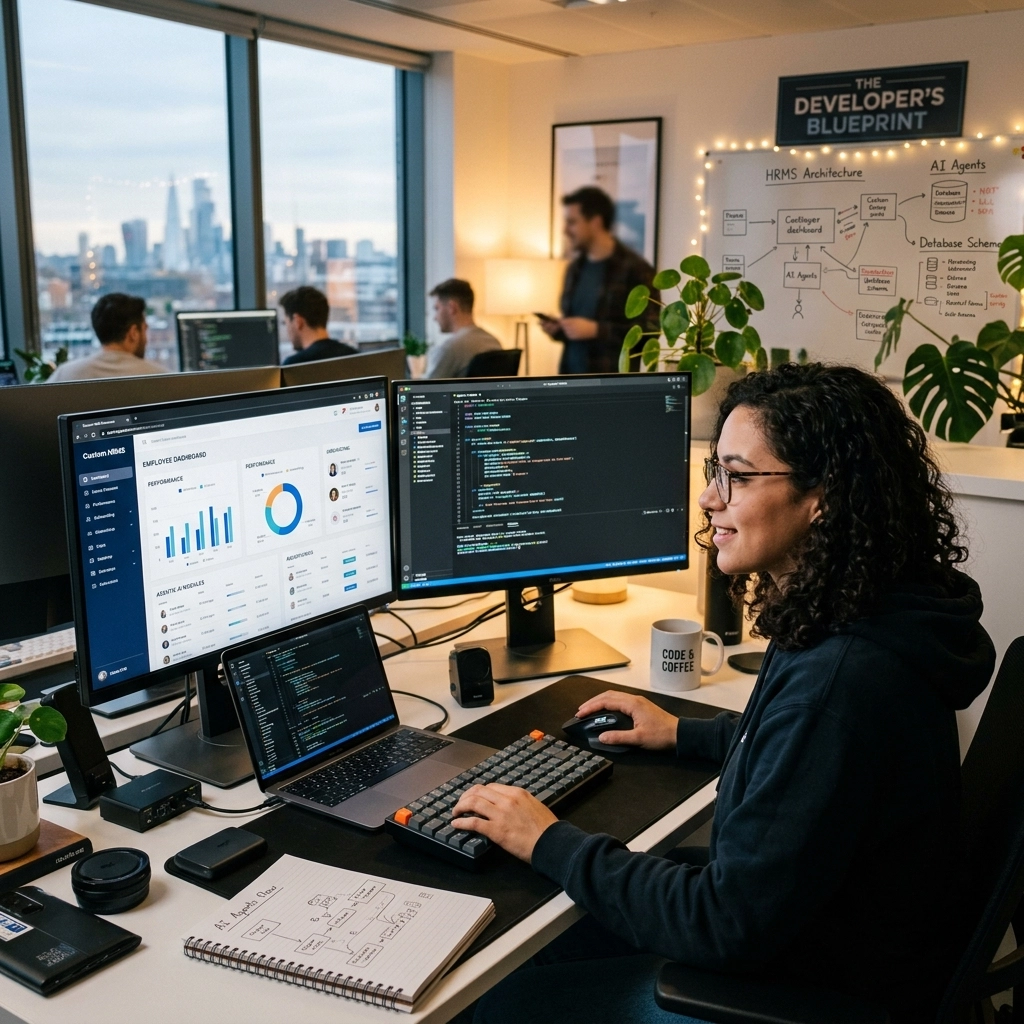
The inflection point happened when we realized that LLMs weren't just generators, they were reasoners. Today, building a sophisticated enterprise tool like a Human Resource Management System (HRMS) isn't about manual CRUD operations anymore. It’s about orchestrating a "digital workforce" of agents that understand your business logic and technical stack. This is the Developer's Blueprint for a new age of custom software development, where the distance between "idea" and "production" is shorter than it’s ever been in human history.
Table of Contents
- Why Custom HRMS?
- Setting up Claude Code (The CLI)
- The Agentic Workflow (How it writes code)
- Essential Commands
- Conclusion: Scaling with NV Seeds
- FAQ: Agentic HRMS Development
Why Custom HRMS?
Most off-the-shelf HRMS platforms are digital straitjackets. They force your unique company culture into rigid database schemas and predefined workflows. Whether it’s a weird payroll edge case or a specific performance review rubric, standard SaaS often fails to adapt. This is why the demand for saas platform development has skyrocketed.
A custom HRMS built with agentic AI allows you to bake your company’s "constitution" directly into the code. Instead of a passive database, you get an active system that:
- Identifies flight risks before the employee even submits a resignation.
- Automates recruitment by matching candidates not just on keywords, but on cultural alignment and projected growth.
- Self-corrects payroll discrepancies by cross-referencing logs across multiple systems.
By moving away from "useless-to-useful" generic software, you’re creating a strategic asset. You aren't just managing people; you’re optimizing the very engine of your business.
Setting up Claude Code (The CLI)
To build at the speed of 2026, you need tools that live where you work. Claude Code (the Anthropic CLI) has become the gold standard for agentic engineering. It’s not just a window to a model; it’s a terminal-based agent with full access to your file system, git, and execution environment.
Here is how you get your environment ready for agent-driven HRMS construction:
- Installation: Ensure you have the latest Node.js environment. Run:
npm install -g @anthropic-ai/claude-code - Authentication: Run
claude authto link your enterprise account. - Project Initialization: Navigate to your project root and run
claude init. This allows the agent to index your existing codebase and understand your architectural patterns (be it Next.js, Go, or Python).
(Witty but true note: Giving an AI agent access to your terminal feels like giving a teenager the keys to a Ferrari. It’s powerful, a bit scary, and will get you where you’re going much faster if you set the right guardrails.)
The Agentic Workflow (How it writes code)
The secret sauce isn't just "more AI", it’s the Multi-Agent Architecture. In a custom HRMS, you don't want one monolithic agent doing everything. You want a team. Think of it like a dedicated team of virtual engineers.
| Agent Role | Responsibility | Logic Pattern |
|---|---|---|
| The Architect | High-level system design and schema definition. | Planning-First |
| The Feature Lead | Writing specific modules (e.g., Onboarding, Payroll). | Sense-Plan-Act |
| The QA Agent | Writing unit tests and performing adversarial testing. | Verifier |
| The Security Agent | Ensuring GDPR/SOC2 compliance in data handling. | Constraint-Based |
When you prompt Claude Code to "Build a recruitment module," it follows a Sense-Plan-Act cycle.
- Sense: It reads your current
prisma.schemaand existing API routes. - Plan: It creates a step-by-step blueprint (e.g., 1. Create Interview model, 2. Add POST route, 3. Integrate with Calendar API).
- Act: It executes the code, runs the tests, and asks you for feedback if it hits a permission error.

Essential Commands
Working with an agentic CLI requires a shift in how you communicate. You aren't just typing; you're delegating. Here are the "Power User" commands we use daily at NV Seeds to accelerate our gen-ai agent development.
claude "analyze the security of our /api/payroll route": This triggers a deep dive into your auth logic and potential SQL injection vulnerabilities.claude "refactor the Onboarding component to use tailwind-merge and add error boundaries": Great for cleaning up technical debt while you grab a coffee.claude "generate a migration to add 'performance_tier' to the Employees table and update all dependent types": This saves hours of manual TypeScript hunting.claude commit: The agent summarizes your changes and writes a meaningful, context-aware commit message. (No more "fixed stuff" in your git history!)
Pro-Tip Playbook for CLI Success:
- Be Explicit: Instead of "Make it better," say "Optimize the database query in
getSalaryHistoryfor speed." - Incremental Steps: Ask the agent to build the backend first, verify it, then move to the frontend.
- Audit the Plan: Always review the "Plan" the agent generates before hitting "Y" to execute.
Conclusion: Scaling with NV Seeds
Building a custom HRMS with agentic AI is no longer a "future" project, it is the baseline for competitive enterprises in 2026. The ROI is undeniable: lower licensing costs, zero feature-bloat, and a system that actually grows with your workforce rather than hindering it.
However, while the tools are more powerful than ever, the strategy behind them is what determines success. Orchestrating these agents, ensuring data privacy, and integrating complex business logic requires more than just a CLI tool, it requires an architectural vision.
At NV Seeds, we specialize in this exact intersection of custom software development and cutting-edge AI. We don't just write code; we build the intelligent systems that power the next generation of industry leaders. Whether you need to hire developers who are experts in agentic workflows or you're looking for a partner to build a full-scale saas platform, we have the blueprint ready for you.
Ready to stop fighting your HR software and start building your own? Contact us today and let’s turn your vision into code.
FAQ: Agentic HRMS Development
Q: Is it safe to give an AI agent access to my terminal?
A: Yes, provided you use "Human-in-the-loop" mode. Claude Code and similar tools ask for permission before executing destructive commands or writing to the file system.
Q: How much does it cost to build a custom HRMS with AI?
A: While costs vary based on complexity, the "agentic" approach typically reduces development time by 30-50%. For a detailed breakdown, check our guide on app development costs.
Q: Can these agents handle legacy code?
A: Absolutely. One of the greatest strengths of agentic AI is its ability to ingest thousands of lines of legacy code, understand the context, and suggest modernization paths without breaking existing dependencies.
Leave a Reply