By April 2026, the "AI gold rush" has shifted from a frantic land grab to a calculated consolidation. If you’ve spent the last eighteen months chasing the promise of autonomous AI agents, you’ve likely hit a wall. It’s a familiar story: the pilot program showed a 40% productivity spike, the board was thrilled, and then: crickets. The transition from a "cool demo" to a core business driver is where most digital transformation strategies go to die.
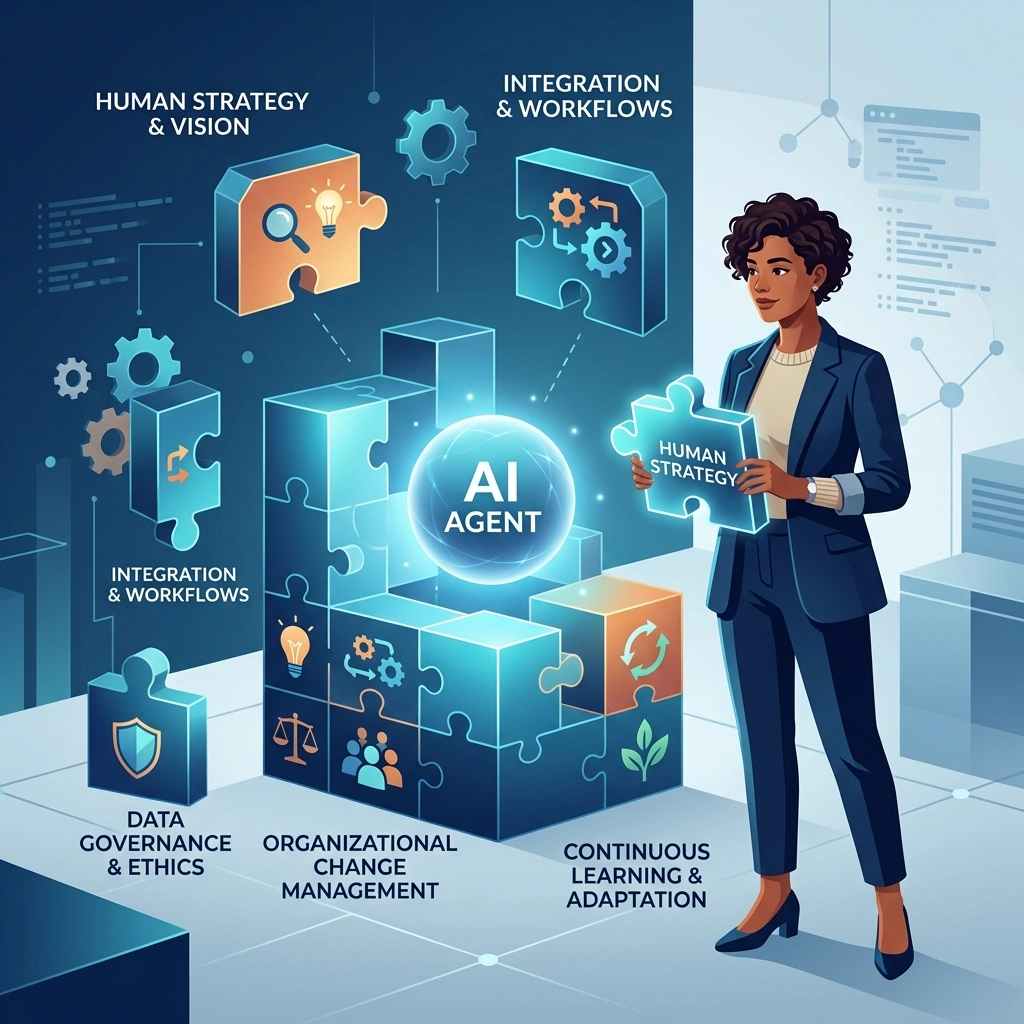
Here’s the hard truth: An AI agent, no matter how sophisticated the underlying LLM, is not a strategy. It is a component.
At NV Seeds, we’ve watched enterprise leaders treat AI agents like "magic wands" they can wave over broken processes to fix them. But an agent without an ecosystem is like a high-performance Ferrari engine sitting on a wooden pallet; it’s powerful, it makes a lot of noise, but it isn’t taking you anywhere.
The Great Disconnect: Why Hype Doesn't Equal ROI
We are currently at an Inflection Point. Organizations are realizing that while AI agents offer a theoretical 35-45% boost in task-level productivity, they often fail to move the needle on top-line revenue or bottom-line efficiency when deployed in isolation.
The problem isn't the AI; it's the Missing Pieces.
The Evolution of Automation (A Quick History Lesson)
To understand where we are, we have to look at how we got here:
- Phase 1: The Script Era (2010-2020): Rigid RPA (Robotic Process Automation) that broke if a pixel moved two inches to the left.
- Phase 2: The Chatbot Renaissance (2022-2023): Generative AI allowed us to talk to our data, but the "data" was often a static PDF.
- Phase 3: The Agentic Shift (2024-Present): Agents that can "reason," "plan," and "execute."
We are now entering Phase 4: The Integrated Ecosystem, where the focus moves away from the agent itself and toward the infrastructure that supports it.

Missing Piece #1: The Grounding Problem & Legacy Friction
Most AI agents are suffering from a "closed world" syndrome. They are brilliant at reasoning within the confines of their training data, but they are functionally blind to your actual business operations.
- Static Knowledge in a Dynamic World: If your agent is assisting with SaaS platform development, but it doesn't have real-time access to your Jira backlog, your current AWS spend, or the latest security patch, it’s giving you advice based on a world that no longer exists.
- The Legacy Chain: Your business likely runs on a mix of modern cloud tools and "the system that Dave built in 2008" which holds all the critical customer data. AI agents struggle with these fragmented tech stacks. Without custom middleware and expert software development, the agent becomes just another siloed tool.
Missing Piece #2: The UI/UX Blind Spot
There is a dangerous assumption that "the chat interface is the only UI we’ll ever need." This is a fallacy.
For complex custom software development, a text box is an inefficient way to manage a project. If an AI agent is refactoring code, you don’t want to read a 1,000-word explanation; you want a visual diff, a performance impact chart, and a "Merge" button.
Human-centric design is not optional. An AI agent needs a "cockpit": a dedicated UI that allows humans to monitor, steer, and override the agent’s actions without needing to write 50-word prompts every five minutes.

Missing Piece #3: The "Human-in-the-Loop" Mandate
Trust is the ultimate currency of digital transformation. If your AI agent is handling content transformation or financial reconciliation, you cannot afford a "hallucination" that costs $50,000.
| Feature | AI Agent Alone | NV Seeds Hybrid Approach |
|---|---|---|
| Decision Logic | Probabilistic (Best guess) | Deterministic + Probabilistic |
| Compliance | Hard to audit | Full audit logs & Human oversight |
| Edge Cases | Likely to hallucinate | Escalates to human expert |
| Security | Susceptible to prompt injection | Multi-layer guardrails |
A "Human-in-the-Loop" (HITL) approach isn't a sign of weakness; it’s a requirement for security and compliance. At NV Seeds, we design systems where the AI does the heavy lifting (the "drudge work"), but the final 5%: the nuanced, high-stakes decision-making: is served up to a human expert in an easy-to-digest format.
How NV Seeds Bridges the Gap
We don't just sell you an "agent." We build the architecture that makes the agent useful. Our approach to Gen AI Agent Development involves four critical pillars:
- Strategic Alignment: We start with the Why. Before a single line of code is written, we align the agent’s goals with your ROI metrics.
- Legacy Integration: Our dedicated teams build the "connectors" that allow AI to talk to your old SQL databases and your new Snowflake instances seamlessly.
- Security Architecture: We implement robust guardrails that prevent data leakage and ensure your proprietary IP stays yours.
- Agile Refinement: AI systems aren't "shipped"; they are "nurtured." We use our proven agile methodology to constantly retrain and tune your agents based on real-world feedback.

Your 2026 Playbook: Moving Beyond the Bot
If you’re ready to turn your AI experiments into a powerhouse of efficiency, here is your action plan:
- Audit Your Data Pipes: Ensure your AI has structured, real-time access to the data it needs. No more static knowledge bases.
- Define the "Escalation Path": Explicitly map out what happens when the AI is only 70% confident. Who does it talk to? How is that feedback captured?
- Build the Interface, Not Just the Agent: Invest in custom UI/UX that allows your team to interact with the AI’s output efficiently.
- Focus on "Cost-per-Task": Stop measuring AI success by "engagement" and start measuring it by the reduction in cost-per-successful-outcome.
Frequently Asked Questions
Q: Won’t adding a human-in-the-loop slow down the process?
Actually, it speeds up the outcome. An autonomous agent that makes a mistake requires hours of manual cleanup. A human-steered agent prevents the mistake from happening in the first place, ensuring a higher "first-time-right" ratio.
Q: Is it expensive to integrate AI agents with legacy systems?
The initial investment is higher than a "plug-and-play" bot, but the cost to develop an app that actually works is always lower than the cost of a failed digital transformation. ROI is found in integration, not isolation.
Q: How do we start if our data is a mess?
That’s exactly where we come in. Most of our case studies begin with a "Data Hygiene" phase. You can't have an intelligent agent without intelligent data.
The Bottom Line
AI agents are a transformative technology, but they are not a "set it and forget it" solution. To truly win in the current landscape, you need to combine the raw power of AI with strategic human oversight, custom UI, and deep system integration.
Ready to build an AI strategy that actually scales? Let’s talk.
Leave a Reply