
In the high-stakes theater of 2026 SaaS acquisitions, there is a recurring tragedy. It goes like this: A founder spends five years grinding to reach $5M in Annual Recurring Revenue (ARR). They’ve got a "visionary" product, a solid sales team, and a growth chart that looks like a mountain climber on caffeine. They enter the "dating phase" with a Tier-1 Private Equity firm or a strategic tech giant.
Then comes the Technical Due Diligence.
Two weeks later, the $30M offer is slashed to $18M. Why? Because the buyer’s CTO took one look under the hood and found a "spaghetti-code" nightmare held together by digital duct tape and the prayers of a single overworked developer.
At NV Seeds, we’ve seen it all. With over 500 successful projects delivered, we’ve learned that while your marketing gets you to the table, your code quality determines whether you leave with a gold mine or a participation trophy. In this guide, we’re breaking down why clean architecture is the ultimate leverage in a SaaS exit and how to turn your codebase into your most valuable asset.
The Valuation Trap: Why Revenue Isn't Everything
We are officially in the "Quality Era" of SaaS. The days of "move fast and break things" have been replaced by "move fast with a robust foundation." In the current market, buyers aren’t just purchasing your current cash flow; they are purchasing future scalability.
If your saas platform development was rushed, every new feature your buyer wants to add post-acquisition will cost them 3x more in engineering hours. They know this. And they will bill you for it: right out of your exit price.
The "Due Diligence" Reality Check
When a buyer initiates technical due diligence, they aren't looking for "cool features." They are looking for risks. Specifically:
- Technical Debt: How much will it cost to fix what you broke while rushing to market?
- Scalability: Can this architecture handle 10x the current user load without a total rewrite?
- Security: Are there ticking time bombs in your third-party dependencies?
- Transferability: If your lead dev quits tomorrow, can a new team understand the code?
The Math of a 10x Multiple: The "Clean Code" Premium
Let's talk numbers. Research shows that poor code quality triggers cascading discounts that can gut your valuation by 20% to 50%. On the flip side, a "Gold Standard" codebase acts as a multiplier.
| Technical Deficit | Impact on Valuation |
|---|---|
| Missing Automated Tests | -20% Discount |
| No Source Documentation | -10% Discount |
| Outdated Tech Stack (>4 years) | -15% Discount |
| Obvious Security Vulnerabilities | Deal-Killer / -40% |
| Highly Scalable, Documented Microservices | +15-20% Premium |
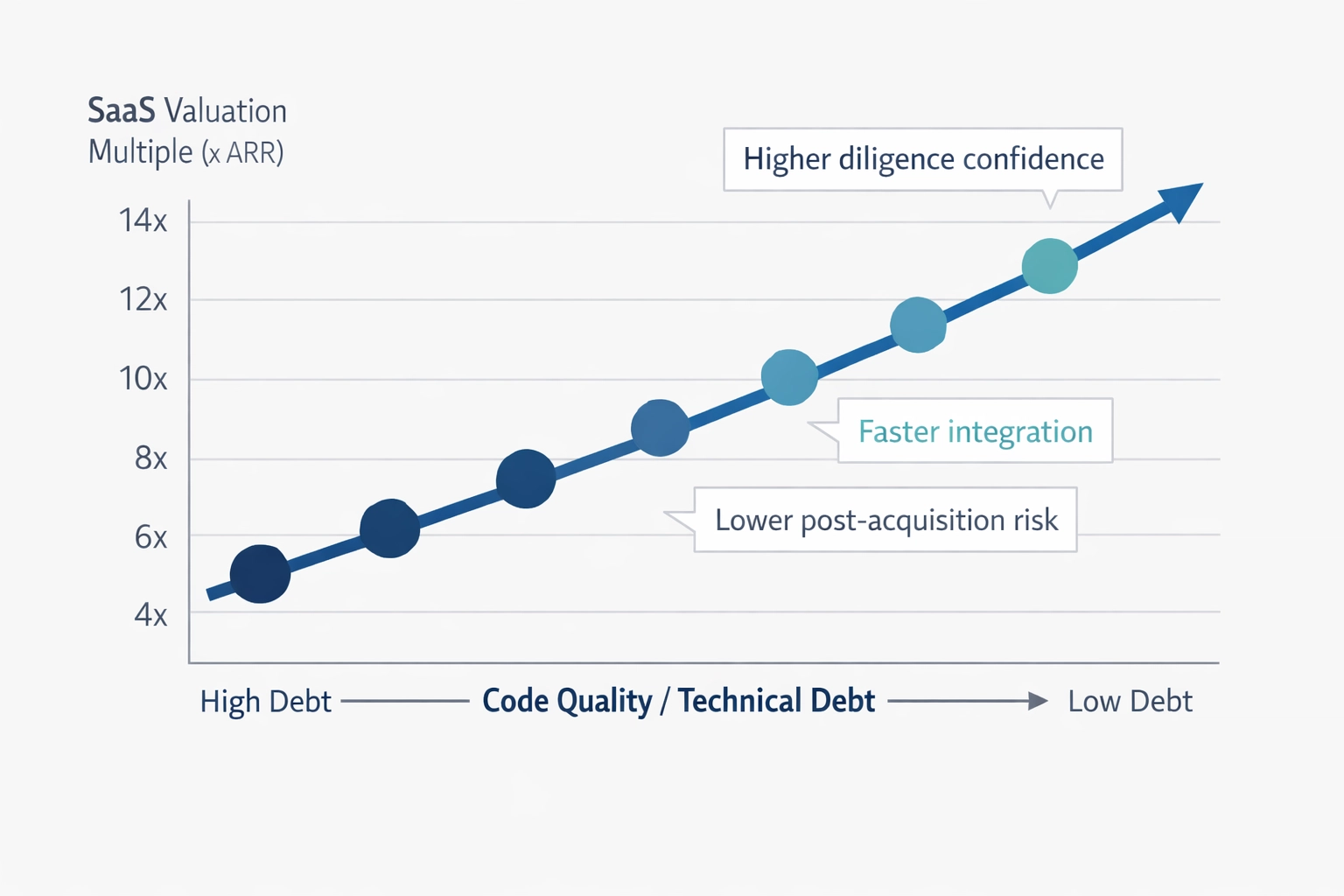
Imagine your SaaS is doing $1M ARR. At a standard 5x multiple, you’re looking at a $5M exit. However, if your codebase is a mess, that 40% cumulative discount drops your payday to $3M. You just "lost" $2M because you didn't invest in custom software development best practices early on
3 Pillars of Acquisition-Ready SaaS Architecture
To hit that 10x multiple, your architecture needs to look like a well-oiled machine, not a Rube Goldberg project. Here are the three pillars we focus on at NV Seeds to ensure our clients are "Built to Sell."
1. Modular, Decoupled Architecture
Buyers love modularity. If your frontend, backend, and database are so tightly coupled that changing a button color breaks the payment gateway, you have a problem. By utilizing agile software development principles, we build systems where components are decoupled. This allows a buyer to integrate your tech into their existing ecosystem with surgical precision.
2. The "Bus Factor" Documentation
The "Bus Factor" is a morbid but necessary metric: If your lead developer got hit by a bus tomorrow, would the company survive? If your code is self-documenting and supported by a robust Wiki, your "Bus Factor" is high (which is good). Buyers pay for systems, not just people. Clean code with clear annotations means a global team of experts can take over the reins on Day 1.
3. Automated Testing as a Safety Net
Manual testing is a relic of the past. In 2026, if you don't have a CI/CD (Continuous Integration/Continuous Deployment) pipeline with at least 80% test coverage, you are handing the buyer a reason to haggle. Automated tests prove to the buyer that the product is stable and that future updates won't trigger a catastrophic meltdown.
The NV Seeds Difference: Building for the Long Game
We don't just write code; we build assets. Whether you are in the early stages or looking to hire dedicated developers to refactor a legacy system, our approach is always geared toward the eventual exit.
- Global Expertise: Our team brings a world-class perspective to every line of code, ensuring it meets international standards for security and performance.
- 500+ Victories: We’ve seen the due diligence checklists of the world's biggest acquirers. We know what they’re looking for before they even ask.
- Agile at Scale: Our agile software development methodology ensures that your product remains flexible, even as it grows into a market leader.
The 12-Month Exit Sprint: An Actionable Playbook
If you are planning to sell your SaaS in the next 12 to 18 months, your "feature factory" days should be over. It’s time for the "Polish Phase." Here is your checklist:
Phase 1: The Audit
Conduct a third-party technical audit. You can't fix what you can't see. Identify your biggest bottlenecks and security holes.
Phase 2: Refactor the "Core"
Don't try to fix everything. Focus on the core IP: the part of the software that actually provides the value. Ensure this part of the codebase is pristine, documented, and modular.
Phase 3: Update the Stack
If you’re running on an ancient version of Node.js or a dying framework, update it. Buyers hate "legacy debt" because it means they’ll have to hire developers with niche, expensive skills just to maintain it.
Phase 4: Security Hardening
In 2026, data privacy is non-negotiable. Ensure you are SOC2 compliant or at least have a clear roadmap toward it. A single data leak during due diligence will kill the deal faster than a bad churn rate.
Most SaaS founders obsess over growth.
Monthly recurring revenue.
Customer acquisition cost.
Churn.
Lifetime value.
And rightly so—these metrics define whether your business survives.
But when it comes time to sell, there’s a quieter, more decisive factor that often determines whether you get a 3x multiple… or a 10x outcome:
Your codebase.
Not your pitch deck.
Not your logo.
Not even your growth curve alone.
Because behind every SaaS product is an invisible asset buyers care deeply about:
the quality, structure, and scalability of your software.
The Misconception: “We’ll Clean It Up Later”
In the early days, speed wins.
Founders ship fast, cut corners, and prioritize survival over perfection. Technical debt feels like a reasonable tradeoff—and often it is.
The problem is what starts as “temporary” debt becomes permanent infrastructure.
- That quick hack becomes a core workflow
- That missing test suite never gets written
- That messy module becomes untouchable
Months turn into years. And suddenly, your product works—but nobody fully understands how.
From the outside, everything looks fine. Revenue is growing. Customers are happy.
But under the hood?
It’s fragile.
And buyers can tell.
Acquirers Don’t Buy Code—They Buy Certainty
Every acquisition is fundamentally about reducing uncertainty.
A buyer is asking:
- Will this system break under scale?
- Can our team understand and extend it?
- How much hidden cost is buried in this codebase?
- Are we buying a product—or inheriting a problem?
A messy codebase introduces unknowns. And in finance, unknowns are priced as risk.
That risk shows up as:
- Lower valuation multiples
- Longer due diligence cycles
- Earn-outs and contingencies
- Or worse… deals falling apart
On the flip side, a clean, well-structured system signals something powerful:
This business is under control.
The Direct Link Between Code Quality and Valuation
Let’s make this concrete.
Imagine two SaaS companies:
Company A
- $3M ARR
- Growing 40% YoY
- Poor documentation
- No automated tests
- Monolithic, tightly coupled code
- Founders are the only ones who understand the system
Company B
- $3M ARR
- Growing 40% YoY
- Clean architecture
- Strong test coverage
- Clear documentation
- Systems designed for scale
Same revenue. Same growth.
But vastly different outcomes.
Company A might get:
- Lower offers
- Heavy due diligence scrutiny
- Payment tied to post-acquisition performance
Company B is more likely to:
- Attract multiple bidders
- Close faster
- Command premium multiples
Why?
Because buyers aren’t just purchasing current cash flow—they’re buying future potential without friction.
Scalability Isn’t a Feature—It’s a Valuation Lever
A SaaS product that works at 1,000 users doesn’t automatically work at 100,000.
Poorly designed systems often hit invisible ceilings:
- Database bottlenecks
- Inefficient queries
- Tight coupling between services
- Rising infrastructure costs
At that point, growth becomes expensive—or worse, impossible without a rewrite.
And rewrites are scary for acquirers.
They mean:
- Delayed ROI
- Engineering risk
- Opportunity cost
A scalable system, on the other hand:
- Handles growth predictably
- Keeps margins healthy
- Supports expansion into new markets
That scalability directly increases how much someone is willing to pay.
Developer Velocity: The Hidden Growth Multiplier
Post-acquisition, buyers want momentum—not stagnation.
They’re asking:
“How quickly can we build on top of this?”
Low-quality code slows everything down:
- Every feature takes longer
- Bugs are harder to fix
- Changes introduce unintended side effects
High-quality systems do the opposite:
- Engineers move faster
- Experimentation becomes easier
- New ideas reach production quickly
This is critical because:
Your acquisition price is often based on future upside—not just current performance.
If your codebase enables speed, you’re selling a growth engine.
If it slows things down, you’re selling a constraint.
Technical Due Diligence: Where Deals Are Won or Lost
At some point in the acquisition process, things get real.
Buyers bring in technical experts to evaluate your system.
They look at:
- Code structure and readability
- Test coverage
- Deployment processes
- Security vulnerabilities
- Dependency health
- System architecture
This is where hidden issues surface:
- “Why is this service tightly coupled to three others?”
- “What happens if this module fails?”
- “Why are there no tests here?”
If too many red flags appear, one of three things happens:
- The price drops
- The terms get stricter
- The buyer walks away
A strong codebase doesn’t just pass diligence—it builds confidence.
And confidence accelerates deals.
The Founder Dependency Trap
One of the biggest red flags in acquisitions is founder dependency.
If your system only works because:
- You understand every corner of it
- You manually fix issues
- You’re the only one who can make major changes
…then the business isn’t truly transferable.
Buyers don’t want to acquire a job. They want to acquire a system.
Clean code, documentation, and clear architecture reduce this dependency.
They turn your company from:
- “Founder-driven”
into - “System-driven”
And system-driven businesses are far more valuable.
Optionality: Better Code Attracts Better Buyers
High-quality code doesn’t just increase value—it increases who’s interested.
Different buyers care about different things:
- Strategic acquirers want easy integration
- Private equity firms want efficiency and predictability
- Enterprise buyers want reliability and compliance
A messy system limits your audience.
A clean system expands it.
And when multiple buyers compete, valuation increases naturally.
What “Acquisition-Ready” Code Actually Looks Like
You don’t need perfection. But you do need discipline.
Key characteristics include:
1. Modular Architecture
Clear separation of concerns. Components that can evolve independently.
2. Automated Testing
Confidence that changes won’t break core functionality.
3. Documentation
So new engineers (or buyers) can understand the system quickly.
4. Scalable Infrastructure
Designed to handle growth without major rewrites.
5. Clean Dependencies
No outdated or risky libraries.
6. Observability
Monitoring, logging, and alerting built in.
7. Security Awareness
Basic best practices implemented and maintained.
The Long-Term Mindset Shift
The biggest shift founders need to make is this:
You’re not just building for today’s users.
You’re building for tomorrow’s buyer.
Every shortcut has a cost.
Every clean abstraction has value.
Every test, every document, every architectural decision compounds over time.
Final Thoughts
In SaaS, your codebase isn’t just an implementation detail.
It’s the foundation of your valuation.
Revenue might get you noticed.
Growth might get you meetings.
But when it’s time to sell:
Code quality is what determines whether you walk away with a good exit—or a great one.
Because at the end of the day:
The best businesses aren’t just profitable.
They’re transferable, scalable, and trustworthy.
And that all starts with the code.
Frequently Asked Questions (FAQ)
1. Will a buyer really look at my source code?
Absolutely. For any significant acquisition (usually anything over $2M-$5M), a buyer will hire an external firm to perform a deep-dive technical audit. They will look at your Git history, your test coverage, and your architectural diagrams.
2. Can I just "fix" the code during the due diligence period?
No. Due diligence is usually a 30-to-90-day window. That’s enough time to find problems, but rarely enough time to fix them. If you try to rush a refactor during the deal, you risk breaking the product while the buyer is watching.
3. How much does it cost to "clean up" a SaaS for exit?
It depends on the level of technical debt. However, the cost is almost always lower than the valuation discount you’ll take if you don't do it. Think of it like staging a house before a sale: you spend $10k to make $100k. You can check our guide on app development costs to get a baseline.
4. Why should I choose NV Seeds for my SaaS development?
We specialize in building high-growth, high-quality platforms. With a global team and a track record of 500+ successful projects, we know how to bridge the gap between "it works" and "it’s worth $50M."
The Bottom Line
Your SaaS isn't just the service it provides; it’s the code that powers it. In the eyes of an acquirer, code quality is the difference between a high-growth asset and a high-maintenance liability.
Don't let five years of hard work be discounted because of messy architecture. Whether you're just starting or you're ready to prep for the big payday, investing in high-quality saas platform development is the smartest financial move you can make.
Ready to build an exit-ready SaaS? Contact NV Seeds today and let’s turn your code into your greatest competitive advantage.
Leave a Reply