
If you are still building a SaaS platform that requires a human to log in, stare at a complex dashboard, and manually click "Export to PDF" just to get a task done, I have some difficult news: You aren't building a solution. You’re building a chore.
Welcome to April 2026. The "Software as a Service" (SaaS) era as we knew it: defined by seats, licenses, and manual UI navigation: has reached its expiration date. We have officially crossed the threshold into the era of Agentic-as-a-Service (AgaaS).
The shift isn’t just a rebranding exercise. It’s a fundamental structural change in how code creates value. While SaaS provides you with the tools to do work, AgaaS provides you with the work itself.
At NV Seeds, we’ve spent the last decade navigating these technological shifts across 500+ projects. We’ve seen the "Inflection Point," and we’re here to help you build for the future, not the rearview mirror.
The Three Phases of Software Evolution
To understand where we are going, we have to look at where we’ve been. Think of it as a historical lap through the "Value Extraction" olympics:
- Phase 1: The Heavy Metal Era (On-Prem): You bought a disc. You installed it. If it broke, you called a guy in a polo shirt. You owned the tool, but you also owned the headache.
- Phase 2: The Browser Era (SaaS): We moved the tools to the cloud. You paid a monthly rent to access them. It was more convenient, but the burden of "doing the work" still sat squarely on your shoulders. You were the pilot; the software was just the cockpit.
- Phase 3: The Autonomy Era (AgaaS): The software is the pilot. You define the destination (the business outcome), and the agentic AI workflow handles the navigation, the fuel management, and the mid-air adjustments.
The bottom line: In 2026, customers don't want to buy a shovel; they want a hole in the ground. AgaaS is the first time software has actually delivered the hole.
What Exactly is AgaaS? (And Why It’s Not Just a Bot)
Let’s clear the air: An AI Agent is not a chatbot. If your "agent" only responds to "Hello" with "How can I help you today?", that’s a legacy liability, not an asset.
AgaaS (Agentic-as-a-Service) is the delivery of autonomous agents that can reason, make decisions, and execute multi-step workflows across disparate systems with minimal human oversight.
| Feature | Traditional SaaS | AgaaS Platform |
|---|---|---|
| User Interaction | Manual Dashboard Navigation | Natural Language / Goal-Based |
| Logic Type | If-This-Then-That (Static) | Reasoning & Planning (Dynamic) |
| Execution | User triggers each step | Agent executes end-to-end |
| Value Metric | Time-on-Platform | Outcome-per-Task |
| Primary Goal | Feature accessibility | Task completion |
Building an agentic AI workflow means creating a system that doesn't just wait for a command. It observes data, orients itself within the business context, decides on the best path, and acts. This is the OODA loop (Observe, Orient, Decide, Act) translated into enterprise-grade custom software development.
The Death of the Dashboard: Why Every SaaS Build is Changing
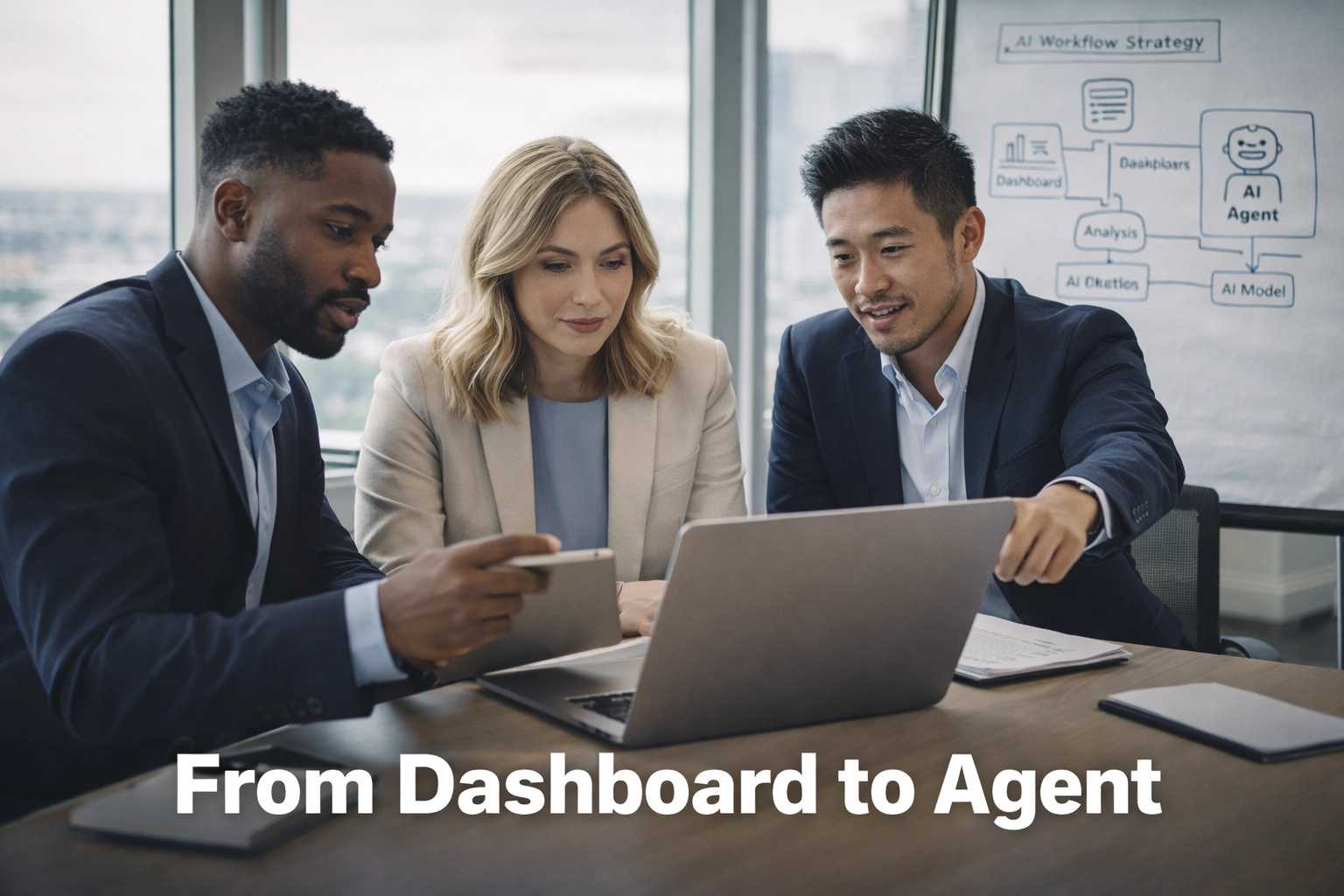
For a decade, the "SaaS Dashboard" was the holy grail of UI/UX. We packed them with graphs, heatmaps, and "actionable insights." But here is a witty-but-true reality: Nobody actually wants to look at your dashboard.
Your users have "dashboard fatigue." They are drowning in "actionable insights" but lack the time to actually take action.
The transition to AgaaS flips the script. Instead of a dashboard that displays a 15% drop in supply chain efficiency, an Agentic platform:
- Detects the drop.
- Identifies the bottleneck (e.g., a delayed shipment in Rotterdam).
- Drafts three alternative logistics routes.
- Calculates the ROI for each.
- Pings the manager on Slack: "Rotterdam is blocked. I’ve secured a 10% faster route via Antwerp for a $200 premium. Should I execute?"
That is the difference between a tool and an agent. When you engage in saas platform development in 2026, your primary "user" might not even be a human: it might be another agent.
Why You Need to Prioritize AgaaS (The ROI Reality)
The cost of launching an AI-powered workflow has approached zero, while the cost of human labor continues to climb. Organizations that fail to move toward agentic architectures risk a "structural legacy" problem.
1. The End of "Seat-Based" Pricing
In the SaaS world, more employees meant more revenue for the software provider. In the AgaaS world, efficiency is the product. As an ai agent development company, we are seeing a shift toward "Performance-Based Pricing." You pay for the task completed, not the person watching the screen. This drastically improves the ROI for the end-user.
2. Eliminating the "Integration Tax"
Traditional SaaS is a silo. You need Zapier, Make, or a team of expensive engineers to make two platforms talk. AgaaS platforms are built to be "Integration-First." They use LLMs to interpret API documentation and connect themselves to your legacy ERP or CRM without a six-month "rip and replace" cycle.
3. Hyper-Scalability
An agent doesn't sleep, doesn't need a "work-life balance" (though we’re sure some philosophers are debating that by now), and can scale from 1 to 1,000 instances in seconds. For businesses, this means your dedicated team can focus on strategy while the agents handle the high-volume, low-context execution.
How NV Seeds Builds the AgaaS Future
Transitioning from a static product to an agentic powerhouse isn't something you do overnight with a few API calls to a generic LLM. It requires deep architectural expertise.
At NV Seeds, we don’t just "add AI." We re-engineer your core logic to support autonomy. With 12+ awards and a portfolio of over 500 successful projects, we’ve refined the process into a science:
- Infrastructure for Autonomy: We build the "sandbox" where agents can safely execute code, call APIs, and manage data.
- Custom Agentic Workflows: We tailor the reasoning engine to your specific industry, whether it’s FinTech, Healthcare, or Logistics. Check out our case studies to see this in action.
- Security & Governance: An autonomous agent is powerful, but it needs guardrails. We implement human-in-the-loop (HITL) checkpoints to ensure the "Agentic Revolution" doesn't become a "Compliance Nightmare."
The AgaaS Transition Playbook: 4 Steps to Start
If you’re planning your next build or an overhaul of your current platform, use this checklist to ensure you’re not building a dinosaur.
- Identify the "Action Gap": Look at your current software. Where does a user have to leave your platform to do something else (e.g., send an email, update a spreadsheet)? That gap is where an agent belongs.
- Define the Goal, Not the Path: Stop hard-coding workflows. Start building systems that can receive a goal (e.g., "Reduce churn by 5%") and determine the steps required to get there.
- Hire for Intelligence, Not Just Interface: Your development team needs to understand vector databases, prompt engineering, and state management. If they’re only focused on the "look" of the app, you’re in trouble. You can hire expert developers who specialize in this at NV Seeds.
- Beta Test with "Agentic Shadowing": Let your AI agents run in the background, suggesting actions to humans before they are allowed to execute them autonomously. This builds trust and refines the reasoning logic.
FAQ: What’s Keeping You Up at Night?
Q: Is AgaaS just a fancy name for automation?
A: Not quite. Automation is a train: it follows a fixed track. AgaaS is a self-driving car: it knows the destination but can navigate around traffic, roadblocks, and changing weather conditions.
Q: Will this replace my human workforce?
A: It replaces the monotony, not the strategy. It allows your team to move from being "data entry clerks" to "agent orchestrators."
Q: How much does it cost to build an AgaaS platform?
A: It depends on the complexity of the reasoning required. We’ve broken down the general economics in our guide on how much it costs to develop an app.
Q: Can I turn my existing SaaS into an AgaaS?
A: Absolutely. Most of our current gen-ai agent development projects involve layering agentic capabilities over existing enterprise software to breathe new life into legacy systems.
The Inflection Point is Now
We are standing at a "State of the Union" moment for the tech industry. The "SaaS Sprawl" of the 2010s is being consolidated into the "Agentic Powerhouses" of the 2020s.
Your next build will either be an autonomous partner for your users or a legacy tool they eventually replace. Don't build for the world of 2021; build for the world of 2026.
Ready to lead the revolution? Contact NV Seeds today and let’s turn your software into an agent that actually gets the job done.

Leave a Reply