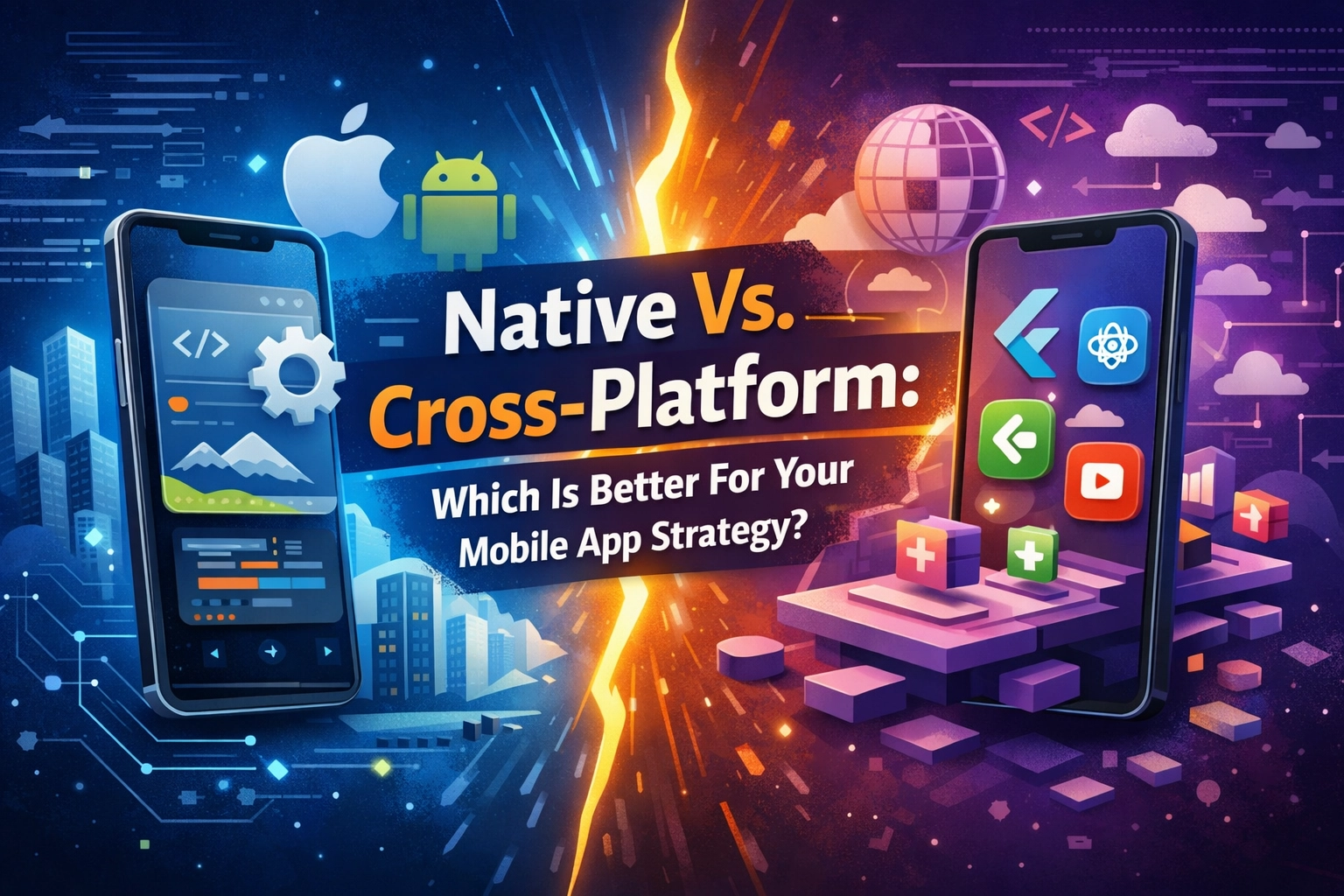
Stop looking for a “winner.” In the 2026 mobile landscape, the debate between Native and Cross-Platform development isn’t about which technology is objectively superior, it’s about which one aligns with your specific business velocity and unit economics.
If you are still following 2022 advice, you are likely overspending on development or underserving your users. We have reached a technical Inflection Point where the performance gap has narrowed to milliseconds, yet the strategic gap between these two approaches has never been wider.
At NV Seeds, we see founders agonize over this choice daily. They fear the “wrong” decision will lead to a complete rebuild in eighteen months. Let’s cut through the vague industry standards and look at the “useless-to-useful” transformations that actually impact your ROI.
The Evolution: From “Janky” to “Seamless”
To understand where we are, we have to look at how we got here. Mobile development has moved through three distinct phases:
- Phase 1 (The Wild West): Native was the only way to get a smooth UI. Hybrid apps were essentially websites wrapped in a container, slow, buggy, and frustrating.
- Phase 2 (The Framework Boom): React Native and Flutter emerged, promising “Write Once, Run Anywhere.” They were great for MVPs but often struggled with complex animations or deep hardware integration.
- Phase 3 (The Renaissance): This is where we sit today. Modern cross-platform frameworks are powerhouse solutions that leverage hardware acceleration, while Native development has become more streamlined with declarative UIs like SwiftUI and Jetpack Compose.
The Native Powerhouse: When Compromise Isn’t an Option
Building native means writing separate codebases for iOS (using Swift) and Android (using Kotlin). Think of it like a custom-built kitchen where every drawer is measured to the millimeter for your specific utensils. It is perfectly optimized for the environment it lives in.
Why Native Still Reigns Supreme for High-Performance
- Direct Hardware Access: If your app relies heavily on the latest LiDAR sensors, complex Bluetooth handshakes, or advanced Gen-AI agent development running on-device, Native is your only choice. It bypasses the “interpreter” layer that cross-platform tools require.
- The “First-Day” Advantage: When Apple or Google releases a new OS feature at their annual conferences, Native developers can implement it immediately. Cross-platform frameworks often require a waiting period for community plugins to catch up.
- Unmatched Smoothness: For compute-intensive applications, think high-end photo editors or real-time data visualization, Native provides a frame rate stability that cross-platform struggles to maintain during heavy processing.
The Cross-Platform Renaissance: Efficiency as a Competitive Edge
For 85% of business applications, the “Native is faster” argument is now a technical ghost story. Modern frameworks like Flutter and React Native provide performance that is indistinguishable from Native to the human eye.
At NV Seeds, our dedicated teams often recommend cross-platform for clients who need to dominate the market quickly without doubling their engineering headcount.
The Strategic Wins of Cross-Platform
- Unified Codebase: You maintain one set of logic. When you find a bug, you fix it once. When you want a new feature, you build it once.
- Lower Total Cost of Ownership (TCO): You don’t just save money on the initial build; you save on every update for the next five years. You don’t need two separate teams of specialized iOS and Android engineers.
- Synchronized Launches: Nothing kills a marketing campaign like “Available now on iOS… and coming soon to Android.” Cross-platform ensures your entire user base gets the same experience at the same time.
The Comparison Matrix: A 2026 Reality Check
| Feature | Native (iOS/Android) | Cross-Platform (Flutter/React Native) |
|---|---|---|
| Development Cost | High (2 separate teams) | Moderate (1 unified team) |
| Time to Market | Slower | Fast |
| Performance | Best (99th percentile) | Excellent (90-95th percentile) |
| UI/UX Consistency | Platform-specific feel | High brand consistency |
| Maintenance | Complex (Two codebases) | Simple (One codebase) |
| Hardware Access | Full / Immediate | Very High / Plugin Dependent |
The Hidden Complexity: The Talent Shortage
One factor often overlooked in the “Native vs. Cross-platform” debate is the human element. If you choose Native, you are essentially doubling your hiring requirements. You need to hire developers who are experts in Swift and developers who are experts in Kotlin.
In a market where top-tier talent is scarce, managing two separate engineering cultures can become a management nightmare. Cross-platform allows for a more cohesive service delivery, where the entire team understands the entire product.
The Hybrid Middle Ground: Kotlin Multiplatform (KMP)
If you’re caught in the middle, 2026 has brought us a “Best of Both Worlds” contender: Kotlin Multiplatform.
KMP allows you to share the “brains” of the app (the business logic, data handling, and networking) while keeping the “face” (the UI) entirely native. It’s like sharing the engine between two different car models. You get the performance of Native UI with the efficiency of a shared codebase.
The “Bottom-Line” Playbook: How to Choose
If you are currently planning your mobile strategy, use this checklist to stop the “analysis paralysis.”
Choose Native If:
- Your app is a high-end game or heavy multimedia editor.
- You are building a “system-level” utility (like a custom keyboard or security suite).
- You have an unlimited budget and require the absolute latest OS features on Day 1.
- Your industry requires specialized on-device encryption that is only available via native APIs.
Choose Cross-Platform If:
- You are building a CRUD app (Create, Read, Update, Delete) like an e-commerce platform, social network, or business tool.
- You need to get to market in under 4 months.
- You want to keep your development team lean and agile.
- Your UI is highly branded and needs to look identical on both platforms.
The NV Seeds Verdict
Choosing your tech stack isn’t just a coding decision; it’s a financial one. We’ve seen companies burn through their seed funding because they insisted on Native development for a simple delivery app. Conversely, we’ve seen startups hit a “performance wall” because they tried to build a real-time AR tool using a basic hybrid wrapper.
The “Right” choice is the one that allows you to scale without the tech stack becoming an anchor. Whether you need a content transformation of your current mobile strategy or a fresh build from scratch, focus on the maintenance-to-innovation ratio
Frequently Asked Questions
Is cross-platform development cheaper in the long run?
Generally, yes. You save roughly 30-40% on initial development costs and significantly more on long-term maintenance since you are only updating one codebase.
Will my users know if my app is cross-platform?
In 2026, the answer is almost certainly “No.” Modern frameworks provide 60fps+ performance and access to all standard haptics and gestures that make an app feel “right.”
Can I switch from Cross-Platform to Native later?
It’s not a “switch”; it’s a rewrite. While you can reuse your backend and API logic, the mobile front-end would need to be rebuilt. This is why getting the strategy right at the start is vital. You can view our case studies to see how we’ve helped others make this transition successfully.
Which framework is winning in 2026?
Flutter and React Native remain the “Big Two,” with Kotlin Multiplatform rapidly gaining ground for enterprise solutions that demand native performance with shared logic.
Ready to build? Contact us today to discuss which mobile strategy will drive the highest ROI for your vision.
Leave a Reply